স্টিফেন হকিং খুব সাহসী একটা কাজ করে ফেলেছেন – যেটা তার স্বভাবের সাথে একদমই যায় না। তিনি সরাসরি বলেছেন – মহাবিশ্ব ‘সৃষ্টি’র পেছনে ঈশ্বরের কোন ভূমিকা নেই। মহাবিশ্ব পদার্থবিজ্ঞানের নিয়ম নীতি অনুসরণ করে স্বতস্ফুর্তভাবে তৈরি হয়েছে। মহাবিশ্বের উৎপত্তি এবং অস্তিত্বের ব্যাখ্যায় ঈশ্বরের আমদানি একেবারেই অযথা।
সাহসী কাজটা করলেন বটে – কিন্তু ব্যাপারটি তার স্বভাববিরুদ্ধ, প্রথমেই সেটা বলে নিয়েছি। স্বভাবের সাথে যায় না বলেছি কারণ, হকিং তার পাঠকদের বিশ্বাস-অবিশ্বাসের দোলাচলে ঠেলে দিয়ে ঈশ্বরকে নিয়ে মায়াবী কাব্য করতে পছন্দ করতেন। ১৯৮৮ সালে প্রকাশিত তার বিপুল জনপ্রিয় বই – ‘ব্রিফ হিস্ট্রি অব টাইম’ বৈজ্ঞানিক যুক্তিতে ভরপুর, এমনকি শূন্য থেকে কী ভাবে মহাবিশ্ব উদ্ভুত হতে পারে তারও সম্ভাব্য ধারনা আছে ওতে -- কিন্তু বইয়ের শেষ লাইনটিতে এসেই প্যান্ডোরার বাক্সের মতোই রহস্যের ঝাঁপি মেলে দিয়েছিলেন হকিং ; বলেছিলেন – যেদিন আমরা সার্বজনীন তত্ত্ব (Theory of every thing) জানতে পারব, সেদিনই আমাদের পক্ষে সম্ভব হবে ‘ঈশ্বরের মন’ (mind of god) কে পরিপূর্ণভাবে বোঝা[1]।
তারপর থেকে হকিং এর বলা এই ‘মাইণ্ড অব গড’ নিয়ে হাজারো ব্যাখ্যা আর প্রতিব্যাখ্যা করা হয়েছে। কেউ বলেছেন ‘মাইণ্ড অব গড’ ব্যাপারটা হকিং তার বইয়ে কেবল কাব্যময় রূপক হিসেবে ব্যবহার করেছেন, সত্যিকার ঈশ্বরকে বোঝাননি, আবার আরেকদল বললেন, ‘মাইণ্ড অব গড’-এর মাধ্যমে হকিং ঈশ্বরের ব্যাপারটাতে আনুষ্ঠানিক স্বীকৃতি দিয়েছেন। এতে নাকি প্রমাণিত হয়েছে যে বিজ্ঞানের দরবারে ঈশ্বর বলে সত্যই কিছু একটা আছে। তর্ক-বিতর্কে রঙ্গমঞ্চ জমজমাট ছিলো পুরোটা সময়েই কিন্তু কোন সমাধান পাওয়যা যায়নি। জ্যোতির্পদার্থবিদ পল ডেভিস তো একখানা ঢাউস বইই লিখে ফেলেছেন ‘মাইণ্ড অব গড’ শিরোনামে ১৯৯২ সালে[2]। তবে হকিং কথিত ‘মাইণ্ড অব গড’ এর অন্তর্নিহিত তাৎপর্য কি ছিলো, উহা দ্বারা কি কি ব্যাখ্যা করা হইয়াছে – তাহা শুধু হকিং এর মস্তিস্কই বলিতে পারে। তবে দুর্মুখেরা বলেন, ‘মাইণ্ড অব গড’ নিয়ে অনর্থক ধোঁয়াশা সৃষ্টি করেছিলেন তার প্রথম বইয়ের পাবলিসিটি তথা প্রচারের স্বার্থে। ঐ মাইণ্ড অব গড নামক একটি বাক্যবন্ধের জন্যই নাকি বইয়ের কাটতি বেড়ে গিয়েছিলো বিশগুণ!
অবাক ব্যাপার হচ্ছে এবারে কিন্তু এই ‘ধরি মাছ না ছুঁই পানি’ অবস্থান থেকে পুরোপুরি সরে এসেছেন হকিং। তার নতুন বই ‘গ্রাণ্ড ডিজাইন’ (বিজ্ঞানী লিওনার্ড ম্লোডিনোর সাথে যুগপৎ ভাবে লেখা, এবং এই সপ্তাহেই প্রকাশিতব্য) -এ খুব চাঁচাছোলা ভাবেই বলেন –
‘অভিকর্ষ শক্তির সূত্রের মতো পদার্থবিজ্ঞানের বিভিন্ন সূত্র কার্যকর রয়েছে, তাই একদম শূন্যতা থেকেও মহাবিশ্বের সৃষ্টি সম্ভব এবং সেটি অবশ্যম্ভাবী। ‘স্বতঃস্ফূর্তভাবে সৃষ্টি’ হওয়ার কারণ থেকেই মহাশূন্যে অনেক কিছুর অস্তিত্ব দেখতে পাচ্ছি আমরা। মহাবিশ্বে আমাদের অস্তিত্ব থাকার কারণ হচ্ছে ‘স্বতঃস্ফূর্তভাবে কোনো কিছু সৃষ্টি’ হওয়ার এই নিয়ম। এ কারণেই মহাবিশ্ব টিকে আছে। মহাবিশ্ব সৃষ্টির জন্য কোন প্রয়োজন নেই ঈশ্বরের।’
আসলে হকিং এর বক্তব্যটা তিনি আলাদা করে কোথাও দেননি। লণ্ডনের টাইমস পত্রিকা তার এ সপ্তাহে প্রকাশিতব্য নতুন বইটি ফীচার করতে গিয়ে বইয়ের কিছু অংশ প্রকাশ করে সেপ্টেম্বর মাসের দুই তারিখে। সেখানেই ঈশ্বর সম্বন্ধে হকিং এর পরিবর্তিত ধারণা পাঠকদের সামনে উঠে আসে। টাইমসে প্রকাশিত সেই অংশবিশেষ থেকে দেখা যায়, হকিং বলছেন যে, বিগ ব্যাং কোন স্বর্গীয় হাতের ফসল কিংবা ফ্লুক ছিলো না। পদার্থবিজ্ঞানের সূত্র মেনেই প্রাকৃতিকভাবে বিগ ব্যাং এর মাধ্যমে অনিবার্যভাবেই শূন্য থেকে মহাবিশ্ব উদ্ভুত হয়েছে।
Ailing theory
Ailing theory
Many physicists expect to understand the nature of dark matter and dark energy in due course. However, others believe that these concepts are merely symptoms of an ailing theory and are looking at alternative models of gravity that can explain observations without invoking dark matter or dark energy. One alternative is modified Newtonian dynamics (MOND), and its generalized partner tensor–vector–scalar (TeVeS) theory, which is supposed to obviate the need for dark matter. Another is f(R) gravity, which does away with dark energy.
Now, Radoslaw Wojtak and colleagues at the University of Copenhagen have used data from the Sloan Digital Sky Survey to test these theories against one another. The study focuses on the gravitational redshift of galaxies within galaxy clusters. This quantity describes how much energy it costs photons to leave a cluster. As they leave and lose energy, the photon wavelengths stretch to the red side of the spectrum. Importantly, the different models of gravity predict different amounts of redshift.
Unfortunately, measuring the gravitational redshift is not easy. There are other sources of redshift including the universe's expansion and the individual motions of galaxies within a cluster. Wojtak and colleagues therefore calculated the average redshift as a function of distance from the cluster's centre – a process that should exclude these other sources.


Trojan collision may have shaped the Moon
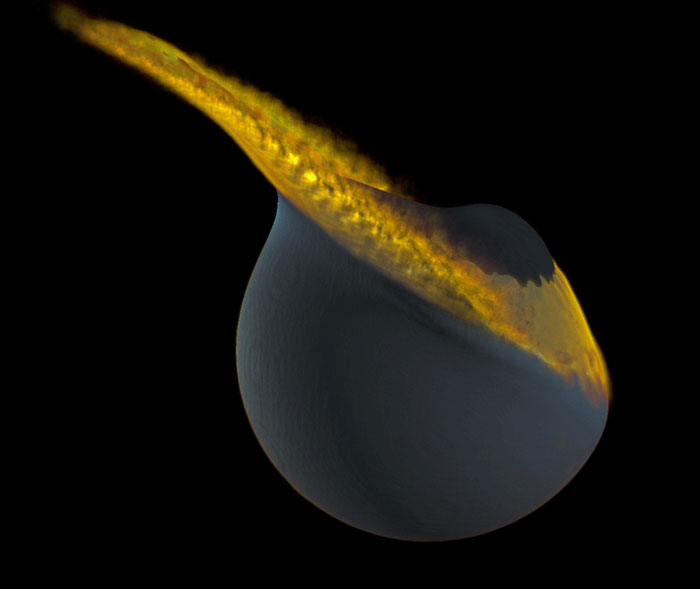
Differences between the near and far sides of the Moon could be the result of a collision between the Moon and a "Trojan" companion that occurred billions of years ago. That is the conclusion of geophysicists in the US and Switzerland who have done computer simulations on how the Moon would be affected by such a massive impact.
Ever since the Luna 3 space mission ventured behind the Moon in 1959, we have known that the nearside and farside of the Moon are different. The nearside (which always faces the Earth) is dominated by relatively smooth basalt plains called "maria", while the farside is mountainous and deeply pitted with craters. The two sides are also believed to be different beneath the surface, with the nearside crust appearing much thinner than the crust on the farside.
Scientists have several theories for why the two sides are so different. These include tidal heating of the Moon by the Earth's gravitational field or a piling up of debris from the huge impact crater at the Moon's south pole.
Now, Martin Jutzi and Erik Asphaug of the University of California, Santa Cruz have done computer simulations that suggest that the lunar farside is the remnant of a collision between the Moon and a smaller companion moon.
Low-speed crash
According to the pair, the companion moon could have been formed at the same time as the Moon – when a Mars-sized planet collided with the Earth shortly after the solar system was formed. This kicked up a vast ring of debris that then orbited our planet, and much of this material is believed to have coalesced rapidly into the Moon. According to Asphaug, it is also possible that one or more smaller moons also formed at stability points within the ring. Such a moon could then have settled into a Trojan orbit, trailing or leading the Moon by 60°. However, this orbit is expected to last only about 100 million years and end with the companion moon crashing into either the Earth or Moon at a relatively low velocity.
It is this latter scenario that Jutzi and Asphaug have modelled using computer simulations. The pair assumed that the companion was about 3% of the mass of the Moon and the two bodies collided at about 2.4 km s–1 or about 8600 km h–1. This velocity is expected in the decay of the Trojan orbit. One important consequence of this slow collision is that the two moons stick together rather than blow apart. "It does not form a crater, but splats material onto one side," explains Asphaug.
The collision velocity is also much slower than the speed of sound in the rocks that make up the moons, which means than the heat generated by the collision is dissipated efficiently and therefore not much melting of rock occurs.
Instead, the simulations suggest that in the aftermath of the collision a new layer of crushed and fragmented rock was deposited that covered one hemisphere of the Moon. The model suggests that the extent and thickness of this layer is consistent with what we know about the surface of the farside of the Moon. What is more, the simulation also predicts that the collision would push much of the Moon’s magma interior towards the nearside – something that is consistent with lunar temperature measurements.
GRAIL's gravity map
The researchers now plan to look for clues of a Trojan collision in new data from the Moon. The pair is particularly interested in the gravity map of the Moon’s interior that will be produced by NASA's GRAIL mission, which is scheduled to launch in September. GRAIL will determine the thickness and structure of the Moon's crust, which can then be compared with specific predictions of Jutzi and Asphaug’s model.
The researchers are also interested in comparing the ages of rocks from the near and farside. If their theory is correct, then rocks on the farside should be older because they formed on the smaller moon – which would have solidified before the much large Moon.
Extraterrestrial life could be extremely rare
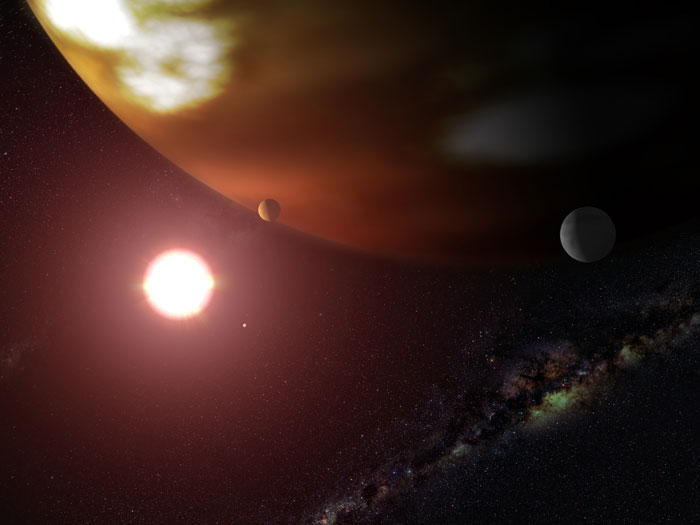
Just because life emerged early on Earth does not mean that this is likely to occur on other Earth-like planets, says a pair of US astrophysicists. The researchers' new mathematical model says that life could just as easily be rare – putting a damper on the excitement surrounding the recent discovery of Earth-like planets orbiting stars other than the Sun.
Estimates of the prevalence of life in the universe suffer from a severe lack of data. Indeed, they only have one data point – Earth – to support them. We are not even certain about whether our nearest neighbour, Mars, ever hosted colonies of microbes. Still, going on the Earth alone, it appears that life arose within a few hundred million years after the seething magma settled into a habitable planet. That seems early, considering that life then evolved for something like 3.8 billion years and looks likely to continue until the Sun balloons into a red giant about around five billion years from now.
"The rapid appearance of life on Earth is probably the best data we have to constrain the probability of life existing elsewhere in the universe, so it deserves to be squeezed as much as possible," says Charley Lineweaver, an astrophysicist at the Australian National University.
Built-in ignorance
Scientists take this one piece of information from the Earth and try to say something about the probability that living organisms will appear elsewhere in a certain amount of time, provided that conditions are favourable. Previous models did not explicitly consider the effect of researchers' prior beliefs on the outcome of these statistical studies. For example, some previous work tried to express ignorance by giving equal weight to every rate at which life could arise. But David Spiegel and Edwin Turner of Princeton University in New Jersey have now shown that this assumption actually dictates the outcome of the analysis.
They used a Bayesian method to reveal the effect of data on models that predict the probability that life arises. The theorem, developed by the 18th-century mathematician Thomas Bayes, combines a theoretical model with "prior" assumptions and data in order to draw conclusions about the probability of certain outcomes.
Because of our ignorance about what conditions are important to spark life, Spiegel and Turner modelled its origin as a "black box". The probability that life arose on a given planet is represented by a Poisson distribution – the same type used to describe radioactive decay – and it depends on the constant probability per unit time that life will arise, and for how long life has had the opportunity to get started.
Thinking about biases
Without at least 3.8 billion years for evolution, humans would not have been around to pose the question of whether life is common in the universe. This biases sentient creatures such as humans towards existing on a planet where life started earlier. The researchers expressed this in the probability that life emerges, adding a dependence on the longest possible delay, that still leaves enough time for humans to appear, between the beginning of habitability and the advent of life.
The key to the prior term in the Bayesian analysis is the rate at which life arises. Giving each rate an equal probability in the prior, the model concluded that life is likely to emerge even without considering the Earth's data. Conversely, by giving each possible delay period between the habitability of a planet and the onset of life the same probability, the model concluded that life rarely arose. Although both priors seem to represent ignorance, they determine the outcome of the calculation, say the researchers. Indeed, the priors build in an unwanted scale, making large rates – or large delay periods – seem more likely.
To get rid of the scale problem, Spiegel and Turner instead gave the logarithm of each rate an equal probability, and they found that the model was much more responsive to data. They considered a variety of possible scenarios for the Earth. For instance, life could have appeared 10 million years after the planet first became habitable, or 800 million years later. If life emerged in less than about 200 million years, then it seems more likely that the rate at which life arises is high. In general, however, the pair's analysis suggests that life is "arbitrarily rare in the universe".
Better fossil data needed
Lineweaver calls the work an "important advance", agreeing that giving all emergence rates an equal probability is "probably too prescriptive on the result". Still, he believes that the approach would benefit from a more sophisticated prior and alternative data. "The result is very sensitive to exactly how rapidly life formed on Earth once it could," he says. He notes that the sparse fossil record gives only the latest limit for when life arose, not an estimate of when life emerged.
Searches for biomarkers, chemicals only known to be produced by living things, in the atmospheres of planets around distant suns could provide more data for these analyses. "The abundance of life in the universe is one of greatest questions of our time," says Don Brownlee, an astrophysicist at the University of Washington in Seattle. "People have probably always pondered this question, but at the present time we actually have tools in hand to gain great insight into its answer."
Flowing water may exist on Mars

Liquid water might exist on Mars today, according to a group of scientists in the US. Images from NASA's Mars Reconnaissance Orbiter (MRO) reveal that dark, narrow, finger-like structures follow slopes in certain regions of the southern hemisphere of the planet during its summer months. The researchers believe that these could be caused by flowing salt water and say the finding raises the tantalizing prospect that there might be life on Mars.
In recent years, satellites in orbit around Mars have shown that ice is likely to exist just below the surface of the planet in mid- to high-latitude regions. Satellite images have also revealed gullies on the walls of Martian craters that may have been created by liquid water flowing down the walls in fairly recent geological history – although some researchers do not agree. However, it is widely agreed that liquid water in the form of long-lived lakes could not be present on Mars today, given average surface temperatures on the planet of about –60 °C and extremely dry conditions.
Now, Alfred McEwen of the University of Arizona and colleagues say the Martian surface may be home to liquid water after all, even if in a somewhat transient state. The discovery came after one of McEwen's colleagues, Lujendra Ojha, analysed two slightly offset images of the same point on the Martian surface taken by the MRO's telescope, the High-Resolution Imaging Science Experiment (HiRISE). The idea was to construct a stereo image in order to perceive depth, but this proved problematic because the details in the images, which were taken at slightly different times, were not identical.
Changing with the seasons
The researchers quickly identified the presence of dark streaks just a few metres wide and up to several hundred metres long that extended down steep rocky slopes and the lengths of which changed over time. By referring to other archive images, and then confirming their discovery with fresh images from HiRISE, the researchers realized that these features were present in a few select places in the southern hemisphere, and that they appeared in Mars’ late spring, grew during the summer and then faded with the onset of autumn or winter.
Another team member, Shane Byrne, says that the researchers "thought long and hard" about what could be causing these streaks. They wondered whether the culprit might be dust avalanching down the slopes and exposing darker material below, but they ruled out this idea because the phenomenon is only visible on slopes that are practically dust-free. Another possibility is that the streaks are caused by melting ice, but the researchers dismissed this because in some of the regions studied the peak daytime temperature at the height of summer reaches 25 °C, which would prohibit the formation of ice for any length of time.
Instead, say the researchers, the streaks are best explained by flowing briny water. Salt, which is known to be widespread on Mars, lowers the freezing point of water, allowing it to exist in its liquid state at temperatures well below 0 °C. Salt also alters the evaporation properties of water, meaning brine can withstand Mars' extremely dry conditions more readily than pure water. As for the darkened surfaces, McEwen and colleagues suggest that the liquid might be sticking fine-grained materials together and causing them to appear dark when usually they would be lighter, but the researchers admit that they cannot explain why the slopes return to their normal colour in winter.
Mysterious streaks
There are more unanswered questions regarding the streaks. Why, for example, have none been found in Mars' northern hemisphere? The team suggests that this could be because of a greater abundance of suitable rocky slopes in the south and the fact that southern summers are warmer. Most importantly, however, the team does not understand where the water comes from. The researchers hypothesize that the water seeps out onto the rocky outcrops having travelled along cracks within the rock until it meets the surface. This suggests that the water is coming from underground, but, as Byrne points out, the temperature just a few metres below the Martian surface, even in the height of summer, is low enough to freeze all but the most exotic brines.
Michael Hecht of NASA’s Jet Propulsion Laboratory in California, who was not involved in the research, believes that the work provides "convincing and exciting" evidence for flowing water on the surface of Mars. He says that McEwen and colleagues are "entirely justified" in pinpointing brine as the explanation, pointing out that Mars is so dry that even at temperatures as low as –70 °C, water can still evaporate. "The only way to have persistent liquid water is to find a way for it to remain liquid near –70 °C," he says. "Brines can do that."
Hecht, however, thinks that the water is probably "scavenged" from the atmosphere, explaining that during the winter the steep slopes in the southern hemisphere are colder than any of the surrounding surfaces and so trap water by preventing it from evaporating.
To prove the brine hypothesis, however, a robotic landing craft will need to be sent to one of the regions with the newly identified features, says Byrne. A lander, he says, would be able to positively identify the existence of liquid water and, if it did so, establish the water’s composition to find out what kind of salts it contains. He adds that such a mission might also be able to hunt for signs of simple life forms, suggesting that unusual types of bacteria might conceivably live in brine water.
Polariton coupling becomes stronger
 Researchers at the University of Pennsylvania in the US claim that polaritons – quasiparticles that are part matter and part light – couple more strongly when confined in nanoscale semiconductors. The new result could benefit photonic circuits that exploit light rather than electricity.
A polariton is a particle-like entity (or quasiparticle) that can be used to describe how light interacts with semiconductors and other materials. It has two different components: an electron-hole pair (or "exciton") and a photon, which is emitted when the electron and hole recombine. When a photon is emitted, it is immediately reabsorbed to reform an exciton, so the cycle is repeated. This continuous exchange, or coupling, of energy between photons and excitons can be described in terms of polariton states.
Polaritons are expected to play an important role in future photonics devices that would use light instead of electricity to process information. Such devices would be much faster and use less energy than their electronic counterparts. The strong coupling of polaritons will be crucial for the success of this new photonics, but the coupling strength of polaritons in bulk semiconductors was always thought to be limited by the properties of the semiconductor material itself.
The right finishing techniques
Ritesh Agarwal and colleagues are now saying that this limit can be overcome if the right fabrication and finishing techniques are used to make the semiconductor structures in question. This is because the light-matter coupling strength increases dramatically as semiconductors become smaller than 500 nm or so, explains Agarwal.
"When you're working at bigger sizes, the surface is not as important," he said. "The surface to volume ratio – the number of atoms on the surface divided by the number of atoms in the whole material – is a very small number. But when you make a very small structure, say 100 nm, this number is dramatically increased. Then what is happening on the surface critically determines the device's properties."
Although researchers had previously attempted to make polariton cavities on such a small scale, the "top-down" chemical etching methods employed to fabricate the devices damaged the semiconductor surfaces, so creating defects. These defects trapped the excitons, making them unavailable for transporting current.
Self-assembling nanowires
Agarwal's team overcame this problem by self-assembling nanowires made from cadmium sulphide instead of etching nanoscale structures. Surface quality was still an issue, even with this fabrication technique, so they developed a way to "passivate" the surface of the nanowires by growing a silicon oxide around them. This greatly improved the optical properties of the wires because the oxide shell fills the electrical gaps in the nanowire surface and prevents the excitons from getting trapped on the surface, says Agarwal.
The scientists also developed techniques (based on detecting the energy of standing waves formed in the nanowire cavities) for measuring the light-matter coupling strength and showed that it was indeed enhanced as the semiconductor structures became smaller. Stronger light-matter coupling means faster photonic switches and much more efficient polariton lasers, light-emitting diodes and amplifiers – to name a few possible applications.
However, not all scientists are convinced of the team's results. Benoit Deveaud-Plédran of École Polytechnique Fédérale de Lausanne described the team's claims as "overstated" and said that they don't appear to be backed up by data presented in a paper outlining the experiment (PNAS 108 10050 ).
Others are more enthusiastic. "This paper looks like an interesting addition to the armoury of light-matter strong coupling effects in semiconductors," commented Jeremy Baumberg of the University of Cambridge's Cavendish Laboratory in the UK. "The results show a new way to reduce the volume of the microcavity, by using high refractive index nanowires, which tightly confine the light inside. The rate at which energy is flipped back and forth between light and excitons depends on inverse square root of the volume within which the light is trapped. Here the wall of the semiconductor is used to confine the light, and it is tighter than normal, giving rise to faster rates and thus a higher splitting between the polariton 'modes'."
Improvements needed
It is an interesting new route to making strong coupled systems at room temperature, he told physicsworld.com, but the design might not be more than just "fortuitous", Baumberg cautions. The light leaks out from the structure in many directions, and is not confined well enough to keep the resonances narrow. "Improvements will rely on much better control of the length, width, orientation and out-coupling of light from nanowires," he added.
Other teams around the world are also looking at new ways of achieving room temperature strong polariton coupling. Baumberg's group, for its part, has recently published a paper in Applied Physics Letters describing a set-up that comprises air suspended mirrors and simpler semiconductors based on the well known gallium arsenide. This system has light out-coupled in only vertical directions and it can be electrically controlled.
Introducing the 'wrinklon'

A new quasiparticle called the "wrinklon" could help explain why materials as diverse as graphene and household curtains wrinkle in much the same way – despite their very different length scales. The particle has been introduced by researchers in Belgium, France and the US as a result of measurements on a wide range of materials on length scales from micrometres to metres. While the work may not lead to more attractive curtains, wrinkles do turn out to affect the electronic properties of graphene and the analysis could therefore influence the development of graphene-based devices.
Wrinkles can appear whenever a sheet of material is fixed along one or more edges. In the case of a fabric curtain, the wrinkles are close together at the top and the space between wrinkles increases continuously further down the curtain. The emergence of wrinklons – by Pascal Damman and colleagues at the universities of Mons, Paris and California Riverside, as well as the Massachusetts Institute of Technology – reflects this change and defines the patterns of wrinkles seen in such materials.
Self-similar patterns
Physicists have enjoyed great success in describing complex systems in terms of quasiparticles – collective excitations that behave much like discrete particles. This latest wrinklon quasiparticle describes a localized region with a high degree of stretching where two wrinkles merge into one (see figure). Indeed, if you happen to be sitting next to a curtain, then you can probably see a few wrinklons, which may appear depending on the tension in the material and its physical properties such as thickness and elasticity.
By studying images of wrinkled materials, the team led by Damman found that the patterns are self-similar. This means that the same pattern occurs in different regions of the material but on different length scales. As Damman explains, "If you look at a photograph of a region of the curtain without knowing the length scale, you can't know where it was taken."
The team demonstrated the universal nature of wrinkling by studying materials as diverse as graphene (a sheet of carbon just one atom thick), curtains made of fabric and rubber, as well as paper and plastic sheets. For each material the team measured the distance between neighbouring wrinkles (the wavelength) as a function of the distance from the fixed edge of the material (the top of a curtain, for example). They also measured the tension on the material – in the case of curtains this is supplied by the downward pull of gravity. The Young modulus (or elasticity) and thickness of the material were also measured.
One power law for all
The team found that the "normalized wavelength" (the wavelength divided by the thickness of the material) of ripples in a number of materials have the same power-law relationship with the "normalized distance" from the fixed edge. This distance includes a term that is a function of the tension, thickness and elasticity of the material.
When plotted on a log–log graph, measurements on materials ranging from graphene to fabric curtains fall on the same line. "This is the best evidence yet that wrinkling occurs in the same way over a wide range of length scales," says Benjamin Davidovitch of the University of Massachusetts, Amherst, who was not involved with the experiment. "It has never been demonstrated with such clarity," he adds.
According to Damman, the findings could be important to those studying graphene. As the wrinklons are affected by the thickness of the material, it should be possible to determine the thickness of a sample simply by looking at its wrinkles. Researchers could therefore distinguish between graphene that is one atom thick and samples that are two or three atoms thick – something that can be difficult to do.
These latest results could also be used to ensure that graphene devices are made wrinkle-free, or with specific patterns of wrinkles. This could be important for those developing electronic devices based on graphene, because the electronic properties of the material are affected by wrinkles. According to Damman's colleague Chun Ning Lau of the University of California, Riverside, devices with desirable properties could be created by "straintronics" – whereby specific wrinkle patterns are created by controlling the strain on graphene.
Physicists break record for extreme quantum state
Physicists in China have broken their own record for the number of photons entangled in a "Schrödinger's cat state". They have managed to entangle eight photons in the state, beating the previous record of six, which they set in 2007. The Schrödinger's cat state plays an important role in several quantum-computing and metrology protocols. However, it is very easily destroyed when photons interact with their surroundings, prompting the researchers to describe its creation in eight photons as "state of the art" in quantum control.
In Erwin Schrödinger's famous thought experiment of 1935, all of the molecules in a cat are in a superposition of two extreme states – living and dead – and an observer cannot tell which until a measurement puts the cat into one of the two states. Today physicists use the term "Schrödinger's cat state" (or Greenberger–Horne–Zeilinger state) to describe any multi-particle quantum system that is in a superposition of extreme states.
For example, a pair of entangled photons can be created in the lab such that they are in a superposition of both photons having horizontal polarization and both having vertical polarization. Entanglement is a quantum effect, which means that particles such as photons can have a much closer relationship than is allowed by classical physics. By measuring the polarization of one of the pair, we immediately know the state of the other, no matter how far apart they are.
The Schrödinger's cat state of eight entangled photons was created by Jian-Weo Pan and colleagues at the University of Science and Technology of China in Hefei. The team began by firing laser light at a nonlinear crystal, which converts single high-energy photons into pairs of entangled lower-energy photons with perpendicular polarizations. The polarization of one of the photons was then rotated by 90°, which puts each pair into a two-photon Schrödinger's cat state.
Pairing up photons
Pan and colleagues then took one photon from each pair and combined the quartet in an optical network consisting of three polarizing beam splitters. One photon leaves each of the network's four outputs only if all four photons have the same polarization. As there is no way of knowing what this common polarization is, the photons are therefore entangled in a Schrödinger's cat state. But as each of the four photons is already entangled with one other photon, all eight photons are therefore entangled in a Schrödinger's cat state.
This entanglement was established by measuring the polarizations of the eight photons as they emerged from the experiment. This reveals the "fidelity" of the eight-photon Schrödinger's cat state, which effectively says how close the different states are to the ideal Schrödinger's cat. The team measured a fidelity value of 0.708 – much larger than the threshold value of 0.5, above which a state is considered to be entangled.
According to Xiao-Qi Zhou of the University of Bristol, UK, Pan and team were able to entangle eight qubits because they managed to separate the photons into "ordinary light" and "extraordinary light". Both types are produced by parametric down conversion and ensuring that four extraordinary photons are sent for further entanglement boosts the efficiency of the process.
Hyper-entanglement could be next
Pan told physicsworld.com that there are several ways that the team can take this work forward. One is to use "hyper-entanglement" to create a 16-qubit Schrödinger's cat state for their eight photons. Hyper-entanglement makes use of more than one degree of freedom of the photon – momentum and polarization, for example – which multiplies the number of states that can be entangled. In 2008 the team used hyper-entanglement to create a 10-state Schrödinger's cat state using five photons.
Zhou points out that the technique of separating ordinary and extraordinary light could also be used to entangle six photons at a higher efficiency than previously possible. This, he thinks, could be used to create a wide range of different entangled states that could be used in quantum computing.
The Schrödinger's cat state could be particularly useful for quantum error correction, which protects a quantum computation from the destructive effects of noise. For example, one bit of quantum information (a qubit) could be encoded into all eight photons of a Schrödinger's cat state. If the polarization of one of the eight photons is inadvertently flipped, for example, this can be corrected by determining the value of the other seven photons.
In Erwin Schrödinger's famous thought experiment of 1935, all of the molecules in a cat are in a superposition of two extreme states – living and dead – and an observer cannot tell which until a measurement puts the cat into one of the two states. Today physicists use the term "Schrödinger's cat state" (or Greenberger–Horne–Zeilinger state) to describe any multi-particle quantum system that is in a superposition of extreme states.
For example, a pair of entangled photons can be created in the lab such that they are in a superposition of both photons having horizontal polarization and both having vertical polarization. Entanglement is a quantum effect, which means that particles such as photons can have a much closer relationship than is allowed by classical physics. By measuring the polarization of one of the pair, we immediately know the state of the other, no matter how far apart they are.
The Schrödinger's cat state of eight entangled photons was created by Jian-Weo Pan and colleagues at the University of Science and Technology of China in Hefei. The team began by firing laser light at a nonlinear crystal, which converts single high-energy photons into pairs of entangled lower-energy photons with perpendicular polarizations. The polarization of one of the photons was then rotated by 90°, which puts each pair into a two-photon Schrödinger's cat state.
Pairing up photons
Pan and colleagues then took one photon from each pair and combined the quartet in an optical network consisting of three polarizing beam splitters. One photon leaves each of the network's four outputs only if all four photons have the same polarization. As there is no way of knowing what this common polarization is, the photons are therefore entangled in a Schrödinger's cat state. But as each of the four photons is already entangled with one other photon, all eight photons are therefore entangled in a Schrödinger's cat state.
This entanglement was established by measuring the polarizations of the eight photons as they emerged from the experiment. This reveals the "fidelity" of the eight-photon Schrödinger's cat state, which effectively says how close the different states are to the ideal Schrödinger's cat. The team measured a fidelity value of 0.708 – much larger than the threshold value of 0.5, above which a state is considered to be entangled.
According to Xiao-Qi Zhou of the University of Bristol, UK, Pan and team were able to entangle eight qubits because they managed to separate the photons into "ordinary light" and "extraordinary light". Both types are produced by parametric down conversion and ensuring that four extraordinary photons are sent for further entanglement boosts the efficiency of the process.
Hyper-entanglement could be next
Pan told physicsworld.com that there are several ways that the team can take this work forward. One is to use "hyper-entanglement" to create a 16-qubit Schrödinger's cat state for their eight photons. Hyper-entanglement makes use of more than one degree of freedom of the photon – momentum and polarization, for example – which multiplies the number of states that can be entangled. In 2008 the team used hyper-entanglement to create a 10-state Schrödinger's cat state using five photons.
Zhou points out that the technique of separating ordinary and extraordinary light could also be used to entangle six photons at a higher efficiency than previously possible. This, he thinks, could be used to create a wide range of different entangled states that could be used in quantum computing.
The Schrödinger's cat state could be particularly useful for quantum error correction, which protects a quantum computation from the destructive effects of noise. For example, one bit of quantum information (a qubit) could be encoded into all eight photons of a Schrödinger's cat state. If the polarization of one of the eight photons is inadvertently flipped, for example, this can be corrected by determining the value of the other seven photons.
The dark-energy game
The universe is not like a clock, where well-understood parts tick in predictable ways, nor like a balloon expanding or contracting. It is in fact pushing itself apart with a strange kind of energy, and 96% of it is made of an unknown kind of matter. How we discovered this is the subject of The 4% Universe, which condenses the complex, messy and startling tale – people, science, instruments, events – into an easily digestible, fast-paced 243 pages. That is a startling achievement in itself. To the connoisseur of popular science, indeed, the way author Richard Panek tells the tale is as interesting as the events: half drama, half detective story.
The prologue begins with a one-page "wow!" moment. On 5 November 2009 scientists at 16 institutions around the world dropped their collective jaws as they seemed to catch a first-ever glimpse of an entirely new structure of the universe. Two pages follow explaining its significance. Referring to the year when Galileo first used the telescope to reveal entire new worlds previously unknown to humankind, Panek writes "It's 1610 all over again."
What follows in Act One is the story of how cosmology went from speculation to science: how astronomers discovered that the furniture of the universe was more than planets and stars, and was on the move to boot. The universe "had a story to tell", Panek writes. "Instead of a still life, it was a movie," he says. We learn how scientists uncovered this movie's plot by peering over the shoulders of Act One's two main characters: theoretical physicist Jim Peebles, author of the classic textbook Physical Cosmology on the physics of the early universe; and astronomer Vera Rubin, whose work on the galaxy-rotation problem pointed the way to the idea that the universe contains some amount of "dark" matter, invisible to present-day instruments.
Act Two introduces more characters and "the game", in which two different teams of scientists vie to unravel the plot by finding distant "Type 1a" supernovae. The game is played with telescopes equipped with charge-coupled devices, which revolutionized astronomical photography, and with the Hubble Space Telescope, which peered into hitherto invisible corners of the universe, among other equipment. The first team, the Supernova Cosmology Project (SCP), was led by Saul Perlmutter and Carl Pennypacker, particle physicists at the Lawrence Berkeley National Laboratory who applied the tools of their trade to astronomy. In doing so, Panek observes, "[T]hey weren't drifting towards a new discipline. The discipline was drifting towards them."
The second team was known as High-Z, where Z is a term for redshift. Highly redshifted objects are among the oldest and most distant in the universe, meaning that they would bear the clearest traces of any expansion or contraction. High-Z's main members were Adam Reiss and Brian Schmidt, who hailed from Harvard University and viewed supernovae as their area of expertise. They saw the Berkeley group as being out to "beat them at their own game". While SCP had a six-year head start, High-Z recruited the "old-boy network" to, in effect, beat the Berkeley group at beating them at their own game.
In 1997 the two teams converged – simultaneously, yet reluctantly – on two wild, toothfairy-like ideas: that the universe contained "dark matter they couldn't see and [a] new force they couldn't imagine". In Act Three, all the main characters introduced so far in the drama gather at a meeting where the SCP's results (picked up by discerning newspaper reporters) suggest that "SCP was beating [High-Z] at beating the SCP at beating [High-Z] at their own game". Then High-Z outdid that by securing full credit in the media. The discovery of this new force – soon dubbed "dark energy" – became Science magazine's "breakthrough of the year" in 1998.
The new idea – that the universe's expansion is accelerating – both simplifies things, by explaining a lot of puzzling data, and makes them more complex, by raising a lot of questions.
In Act Four, SCP and High-Z make plans to hunt for answers to one question – dark matter – while struggling over credit for the other, dark energy. The existing picture of the universe turns "preposterous". But as Perlmutter remarks on the final page of the book, what usually attracts physicists to their field is "not the desire to understand what we already know but the desire to catch the universe in the act of doing really bizarre things". And so, at the book's conclusion, while one chapter in astronomy ends, another begins.
Panek tells the story briskly yet warmly, capturing personalities and not overlooking controversies. He chooses characters carefully. Through Rubin, for instance, we not only learn about dark matter, but also what it is like to be a woman in science, literally balancing child and career: textbook in one hand, pram in the other. Panek also has a knack for summarizing developments concisely and efficiently, such as in the following passage about how astronomy became more specialized over time:
You couldn't just study the heavens anymore; you studied planets, or stars, or galaxies, or the Sun. But you didn't study just stars anymore, either; you studied only the stars that explode. And you didn't study just supernovae; you studied only one type. And you didn't study just Type 1a; you specialized in the mechanism leading to the thermonuclear explosion, or you specialized in what metals the explosion creates, or you specialized in how to use the light from the explosion to measure the deceleration of the expansion of the universe – how to perform the photometry or do the spectroscopy or write the code.
Inevitably, Panek makes some compromises, and the seams of his crisp storytelling occasionally show. Galileo is mentioned once too often, and Panek's apothegmatic style can ring precious, as in this remark about the signal from a radio antenna: "[T]his time the source wasn't a radio broadcast from the West Coast. It was the birth of the universe." The reader sometimes feels manipulated, too. That "wow!" moment that kicks things off so dramatically in the prologue? You don't find out until page 197 that it was phoney – not a discovery after all.
Another author might have explored why it initially seemed to be a discovery, why its announcement was hyped even after problems were uncovered, and what this says about science and scientists. But by this time, you are so absorbed in the story that you do not care that much. And the book does convey a good picture of scientists in the act of catching the universe doing really bizarre things – while also showing that this is why they took the job. Give this book to your non-scientist friends to show them what it is all about – and to fellow scientists as a model of how to write popular science.
The prologue begins with a one-page "wow!" moment. On 5 November 2009 scientists at 16 institutions around the world dropped their collective jaws as they seemed to catch a first-ever glimpse of an entirely new structure of the universe. Two pages follow explaining its significance. Referring to the year when Galileo first used the telescope to reveal entire new worlds previously unknown to humankind, Panek writes "It's 1610 all over again."
What follows in Act One is the story of how cosmology went from speculation to science: how astronomers discovered that the furniture of the universe was more than planets and stars, and was on the move to boot. The universe "had a story to tell", Panek writes. "Instead of a still life, it was a movie," he says. We learn how scientists uncovered this movie's plot by peering over the shoulders of Act One's two main characters: theoretical physicist Jim Peebles, author of the classic textbook Physical Cosmology on the physics of the early universe; and astronomer Vera Rubin, whose work on the galaxy-rotation problem pointed the way to the idea that the universe contains some amount of "dark" matter, invisible to present-day instruments.
Act Two introduces more characters and "the game", in which two different teams of scientists vie to unravel the plot by finding distant "Type 1a" supernovae. The game is played with telescopes equipped with charge-coupled devices, which revolutionized astronomical photography, and with the Hubble Space Telescope, which peered into hitherto invisible corners of the universe, among other equipment. The first team, the Supernova Cosmology Project (SCP), was led by Saul Perlmutter and Carl Pennypacker, particle physicists at the Lawrence Berkeley National Laboratory who applied the tools of their trade to astronomy. In doing so, Panek observes, "[T]hey weren't drifting towards a new discipline. The discipline was drifting towards them."
The second team was known as High-Z, where Z is a term for redshift. Highly redshifted objects are among the oldest and most distant in the universe, meaning that they would bear the clearest traces of any expansion or contraction. High-Z's main members were Adam Reiss and Brian Schmidt, who hailed from Harvard University and viewed supernovae as their area of expertise. They saw the Berkeley group as being out to "beat them at their own game". While SCP had a six-year head start, High-Z recruited the "old-boy network" to, in effect, beat the Berkeley group at beating them at their own game.
In 1997 the two teams converged – simultaneously, yet reluctantly – on two wild, toothfairy-like ideas: that the universe contained "dark matter they couldn't see and [a] new force they couldn't imagine". In Act Three, all the main characters introduced so far in the drama gather at a meeting where the SCP's results (picked up by discerning newspaper reporters) suggest that "SCP was beating [High-Z] at beating the SCP at beating [High-Z] at their own game". Then High-Z outdid that by securing full credit in the media. The discovery of this new force – soon dubbed "dark energy" – became Science magazine's "breakthrough of the year" in 1998.
The new idea – that the universe's expansion is accelerating – both simplifies things, by explaining a lot of puzzling data, and makes them more complex, by raising a lot of questions.
In Act Four, SCP and High-Z make plans to hunt for answers to one question – dark matter – while struggling over credit for the other, dark energy. The existing picture of the universe turns "preposterous". But as Perlmutter remarks on the final page of the book, what usually attracts physicists to their field is "not the desire to understand what we already know but the desire to catch the universe in the act of doing really bizarre things". And so, at the book's conclusion, while one chapter in astronomy ends, another begins.
Panek tells the story briskly yet warmly, capturing personalities and not overlooking controversies. He chooses characters carefully. Through Rubin, for instance, we not only learn about dark matter, but also what it is like to be a woman in science, literally balancing child and career: textbook in one hand, pram in the other. Panek also has a knack for summarizing developments concisely and efficiently, such as in the following passage about how astronomy became more specialized over time:
You couldn't just study the heavens anymore; you studied planets, or stars, or galaxies, or the Sun. But you didn't study just stars anymore, either; you studied only the stars that explode. And you didn't study just supernovae; you studied only one type. And you didn't study just Type 1a; you specialized in the mechanism leading to the thermonuclear explosion, or you specialized in what metals the explosion creates, or you specialized in how to use the light from the explosion to measure the deceleration of the expansion of the universe – how to perform the photometry or do the spectroscopy or write the code.
Inevitably, Panek makes some compromises, and the seams of his crisp storytelling occasionally show. Galileo is mentioned once too often, and Panek's apothegmatic style can ring precious, as in this remark about the signal from a radio antenna: "[T]his time the source wasn't a radio broadcast from the West Coast. It was the birth of the universe." The reader sometimes feels manipulated, too. That "wow!" moment that kicks things off so dramatically in the prologue? You don't find out until page 197 that it was phoney – not a discovery after all.
Another author might have explored why it initially seemed to be a discovery, why its announcement was hyped even after problems were uncovered, and what this says about science and scientists. But by this time, you are so absorbed in the story that you do not care that much. And the book does convey a good picture of scientists in the act of catching the universe doing really bizarre things – while also showing that this is why they took the job. Give this book to your non-scientist friends to show them what it is all about – and to fellow scientists as a model of how to write popular science.
Graphene integrated circuit is a first

IBM researchers have made the first graphene circuit in which all of the circuit elements are integrated on a compact single chip. The new circuit is another important step forward for graphene-based electronics and potential applications include wireless communications and amplifiers.
Despite much progress in recent years and the fact that scientists have already made some high-performance graphene-based devices, it still remains challenging to integrate graphene transistors with other components on a single chip. This is mainly because graphene does not adhere very well to the metals and oxides traditionally used in semiconductor-manufacturing processes and because there are no reliable and reproducible techniques yet to make such circuits.
Integrated inductors
Now, Phaedon Avouris and colleagues at IBM's T J Watson Research Center in Yorktown Heights, New York, may have overcome this problem with their new integrated circuit that consists of a graphene transistor and a pair of inductors compactly integrated on a silicon carbide (SiC) wafer. The wafer-scale fabrication process the team developed is compatible with conventional semiconductor-fabrication methods and can be used to produce circuits in high yields.
The researchers synthesized their graphene by thermal desorption of silicon from SiC wafers to form uniform graphene layers on the insulating SiC surface. They then defined the transistor channel using electron-beam lithography, removing graphene outside of channel regions with an oxygen plasma. Inductors were defined by electron-beam lithography and formed by depositing micron-thick aluminium metal onto the wafers. Finally, a 120 nm thick layer of silicon dioxide, deposited by electron-beam evaporation, was used to isolate the inductor loops from the underlying metal interconnects.
The circuits operate as radio-frequency "mixers" up to 10 GHz, says team member Yu-ming Lin. As the name suggests, mixers produce output signals with mixed frequencies and are fundamental components of many electronic communications systems. In their device, the researchers apply two high-frequency signals to the gate and the drain of the graphene circuit. The graphene transistor is modulated by both signals and produces a drain current that contains the mixed frequencies.
Wireless communications
"The circuit, as it stands, could already be used for wireless communications," Lin told physicsworld.com. "And by further optimizing the performance of the graphene transistors, it might be used as an amplifier."
The importance of the work goes beyond the actual circuit demonstrated and other circuits can be made using the same technique, he adds. It could also be applied to different types of graphene materials, including chemical vapour deposited (CVD) graphene films created on metal films. Most importantly, it could be used on silicon and other semiconductors to form hybrid circuits with new functionalities.
The team is now busy working on improving the performance of the transistors by optimizing device structure, graphene quality and the gate dielectric. "We are also developing more complex graphene circuits for even more sophisticated devices," says Lin.
New type of supernova outshines the rest

A new type of supernova that shines up to 10 times brighter than any previously recorded has been discovered by an international team of astronomers. However, the team has yet to explain the exact mechanism that drives this new type of exploding star, with existing models failing to reproduce the radiation emanating from this new class of violent events.
Supernovae – highly energetic events caused by the explosion of a star – can often shine brighter than an entire galaxy for a brief period of time. To date, three mechanisms have been used to explain the vast amount of associated radiation observed by astronomers during these events. However, a team led by Robert Quimby at the California Institute of Technology in the US has identified a batch of six supernovae with radiation properties that cannot be explained by any of the three mechanisms.
The first cause discounted by Quimby was radioactive decay. During the highly energetic explosion of a supernova the temperature skyrockets. This allows heavy elements, including 56Ni, to be synthesized. Their subsequent radioactive decay produces gamma-rays that slow down the rate at which the supernova fades away. Crucially, the explosions observed by Quimby were too short-lived. "These supernovae faded about three times as quickly as those driven by radioactive decay," he explains.
Glowing hydrogen
A second possibility is that surrounding hydrogen-rich material is heated by the energy of the explosion, causing it to radiate light. This hydrogen could have been blown off the stars at an earlier time by stellar winds. However, Quimby could not find any evidence of hydrogen. "No traces were found when we analysed the spectral lines of these supernovae. This meant we were able to rule out an interaction with hydrogen-rich circumstellar material," he says.
The elimination of hydrogen also discounted the third conventional mechanism. In this scenario the hydrogen in the atmosphere of the star is ionized as the explosion tears through it. This fog of ionized hydrogen is opaque to radiation. Over time the hydrogen recombines, the fog clears and the radiation streams outwards. But again, as no hydrogen was observed, this cannot easily explain Quimby's pool of six supernovae.
Instead, this latest research puts forward two alternatives that could explain the sextet. The first is a similar process to the heating of hydrogen-rich material surrounding the star. "Some very massive stars, around 100 times more massive that the Sun, could throw off shells of carbon and oxygen instead," Quimby explains. "If a supernova explodes within a shells, it would heat the shell up." As the shells expand and cool, the supernova gradually fades away.
Rotating neutrons
Quimby's second suggestion invokes magnetars. When a massive star dies in a supernova, it can leave behind a superdense, rapidly rotating bundle of neutrons – a neutron star. If this neutron star is highly magnetized, then it is called a magnetar. The interaction of the intense magnetic field with the surrounding ionized material could be behind the mystery supernovae. "The interaction acts as a brake, slowing down the spinning of the magnetar – a process that releases some of its rotational energy into the supernova ejecta," Quimby says. "This could supply an additional source of energy that would make it brighter than a normal supernova."
However, Quimby does not believe he has everything wrapped up just yet. "These ideas are brand new; they didn't exist 10 years ago. We definitely need to do more work to figure this out," he says. Rubina Kotak, a supernova expert at Queen's University, Belfast, who was not involved in the research, also believes it is tricky. "It is really difficult to say what is powering these explosions as we've only seen a handful of them and we don't have complete observations over the whole event," she told physicsworld.com. "We are all waiting for the next one, which hopefully we can catch early enough to monitor all aspects of it."
Meanwhile, Quimby is using the Hubble Space Telescope (HST) to probe the known supernovae further. "I am using the HST to look at their ultraviolet spectra," he explains. "Hopefully, we can get a better idea of what materials are in the ejecta and place better constraints on how the events evolve over time. This could allow us to work out which of our models is applicable."
Magnetic fields reduce blood viscosity


Researchers in the US claim that exposing a person to a magnetic field could reduce their risk of a heart attack by streamlining the flow of blood around their body. While the work currently remains just a proof-of-principle, the researchers believe that their technique could ultimately provide an alternative to drugs in treating a range of heart conditions.
Heart attacks and stokes can strike for a variety of reasons. But research suggests that all such vascular conditions are linked by one common symptom – high blood viscosity. Drugs such as aspirin are frequently prescribed to help lower blood viscosity, but these can have unwanted side effects often related to irritation of the stomach. Now, an alternative to drugs may be at hand following recent work by Rongjia Tao at Temple University and his colleague Ke Huang at the University of Michigan.
In their experiment, Tao and Huang showed that applying a 1.3 T magnetic pulse to a small sample of blood can significantly reduce it's viscosity. About 8 ml of blood with a viscosity of 7 centipoises (cp) – above healthy limits – was contained at body temperature (37 °C) in a test tube. The tube formed part of a device called a capillary viscometer used to measure viscosities. The sample was then exposed to a magnetic field applied parallel to the direction of flow of blood via a coil around the edge of the test tube. After one minute of exposure to the field, the blood's viscosity had been reduced by 33% to 4.75 cp. With no further exposure to the field, the viscosity had only risen slightly to 5.4 cp after 200 min, which is still within healthy limits.
Blood chains
In a paper accepted for publication in Physical Review E, the researchers describe how the effect is probably caused by the response of red blood cells. These iron-rich cells are the most common type of blood cell and they play the leading role in transporting oxygen around the body. In the presence of a strong magnetic field, the red blood cells form chains that align themselves with the field lines where convoys of red blood cells line up behind a leading cell. This process could enable the cells to pass through the blood in a more streamlined fashion, thus reducing the blood's viscosity.
NASA-Funded Research Discovers Life Built With Toxic Chemical
NASA-funded astrobiology research has changed the fundamental knowledge about what comprises all known life on Earth.
Researchers conducting tests in the harsh environment of Mono Lake in California have discovered the first known microorganism on Earth able to thrive and reproduce using the toxic chemical arsenic. The microorganism substitutes arsenic for phosphorus in its cell components.
"The definition of life has just expanded," said Ed Weiler, NASA's associate administrator for the Science Mission Directorate at the agency's Headquarters in Washington. "As we pursue our efforts to seek signs of life in the solar system, we have to think more broadly, more diversely and consider life as we do not know it."
This finding of an alternative biochemistry makeup will alter biology textbooks and expand the scope of the search for life beyond Earth. The research is published in this week's edition of Science Express.
Carbon, hydrogen, nitrogen, oxygen, phosphorus and sulfur are the six basic building blocks of all known forms of life on Earth. Phosphorus is part of the chemical backbone of DNA and RNA, the structures that carry genetic instructions for life, and is considered an essential element for all living cells.
Phosphorus is a central component of the energy-carrying molecule in all cells (adenosine triphosphate) and also the phospholipids that form all cell membranes. Arsenic, which is chemically similar to phosphorus, is poisonous for most life on Earth. Arsenic disrupts metabolic pathways because chemically it behaves similarly to phosphate.
"We know that some microbes can breathe arsenic, but what we've found is a microbe doing something new -- building parts of itself out of arsenic," said Felisa Wolfe-Simon, a NASA Astrobiology Research Fellow in residence at the U.S. Geological Survey in Menlo Park, Calif., and the research team's lead scientist. "If something here on Earth can do something so unexpected, what else can life do that we haven't seen yet?"
The newly discovered microbe, strain GFAJ-1, is a member of a common group of bacteria, the Gammaproteobacteria. In the laboratory, the researchers successfully grew microbes from the lake on a diet that was very lean on phosphorus, but included generous helpings of arsenic. When researchers removed the phosphorus and replaced it with arsenic the microbes continued to grow. Subsequent analyses indicated that the arsenic was being used to produce the building blocks of new GFAJ-1 cells.
The key issue the researchers investigated was when the microbe was grown on arsenic did the arsenic actually became incorporated into the organisms' vital biochemical machinery, such as DNA, proteins and the cell membranes. A variety of sophisticated laboratory techniques was used to determine where the arsenic was incorporated.
The team chose to explore Mono Lake because of its unusual chemistry, especially its high salinity, high alkalinity, and high levels of arsenic. This chemistry is in part a result of Mono Lake's isolation from its sources of fresh water for 50 years.
The results of this study will inform ongoing research in many areas, including the study of Earth's evolution, organic chemistry, biogeochemical cycles, disease mitigation and Earth system research. These findings also will open up new frontiers in microbiology and other areas of research.
"The idea of alternative biochemistries for life is common in science fiction," said Carl Pilcher, director of the NASA Astrobiology Institute at the agency's Ames Research Center in Moffett Field, Calif. "Until now a life form using arsenic as a building block was only theoretical, but now we know such life exists in Mono Lake."
The research team included scientists from the U.S. Geological Survey, Arizona State University in Tempe, Ariz., Lawrence Livermore National Laboratory in Livermore, Calif., Duquesne University in Pittsburgh, Penn., and the Stanford Synchroton Radiation Lightsource in Menlo Park, Calif.
NASA's Astrobiology Program in Washington contributed funding for the research through its Exobiology and Evolutionary Biology program and the NASA Astrobiology Institute. NASA's Astrobiology Program supports research into the origin, evolution, distribution, and future of life on Earth.
Researchers conducting tests in the harsh environment of Mono Lake in California have discovered the first known microorganism on Earth able to thrive and reproduce using the toxic chemical arsenic. The microorganism substitutes arsenic for phosphorus in its cell components.
"The definition of life has just expanded," said Ed Weiler, NASA's associate administrator for the Science Mission Directorate at the agency's Headquarters in Washington. "As we pursue our efforts to seek signs of life in the solar system, we have to think more broadly, more diversely and consider life as we do not know it."
This finding of an alternative biochemistry makeup will alter biology textbooks and expand the scope of the search for life beyond Earth. The research is published in this week's edition of Science Express.
Carbon, hydrogen, nitrogen, oxygen, phosphorus and sulfur are the six basic building blocks of all known forms of life on Earth. Phosphorus is part of the chemical backbone of DNA and RNA, the structures that carry genetic instructions for life, and is considered an essential element for all living cells.
Phosphorus is a central component of the energy-carrying molecule in all cells (adenosine triphosphate) and also the phospholipids that form all cell membranes. Arsenic, which is chemically similar to phosphorus, is poisonous for most life on Earth. Arsenic disrupts metabolic pathways because chemically it behaves similarly to phosphate.
"We know that some microbes can breathe arsenic, but what we've found is a microbe doing something new -- building parts of itself out of arsenic," said Felisa Wolfe-Simon, a NASA Astrobiology Research Fellow in residence at the U.S. Geological Survey in Menlo Park, Calif., and the research team's lead scientist. "If something here on Earth can do something so unexpected, what else can life do that we haven't seen yet?"
The newly discovered microbe, strain GFAJ-1, is a member of a common group of bacteria, the Gammaproteobacteria. In the laboratory, the researchers successfully grew microbes from the lake on a diet that was very lean on phosphorus, but included generous helpings of arsenic. When researchers removed the phosphorus and replaced it with arsenic the microbes continued to grow. Subsequent analyses indicated that the arsenic was being used to produce the building blocks of new GFAJ-1 cells.
The key issue the researchers investigated was when the microbe was grown on arsenic did the arsenic actually became incorporated into the organisms' vital biochemical machinery, such as DNA, proteins and the cell membranes. A variety of sophisticated laboratory techniques was used to determine where the arsenic was incorporated.
The team chose to explore Mono Lake because of its unusual chemistry, especially its high salinity, high alkalinity, and high levels of arsenic. This chemistry is in part a result of Mono Lake's isolation from its sources of fresh water for 50 years.
The results of this study will inform ongoing research in many areas, including the study of Earth's evolution, organic chemistry, biogeochemical cycles, disease mitigation and Earth system research. These findings also will open up new frontiers in microbiology and other areas of research.
"The idea of alternative biochemistries for life is common in science fiction," said Carl Pilcher, director of the NASA Astrobiology Institute at the agency's Ames Research Center in Moffett Field, Calif. "Until now a life form using arsenic as a building block was only theoretical, but now we know such life exists in Mono Lake."
The research team included scientists from the U.S. Geological Survey, Arizona State University in Tempe, Ariz., Lawrence Livermore National Laboratory in Livermore, Calif., Duquesne University in Pittsburgh, Penn., and the Stanford Synchroton Radiation Lightsource in Menlo Park, Calif.
NASA's Astrobiology Program in Washington contributed funding for the research through its Exobiology and Evolutionary Biology program and the NASA Astrobiology Institute. NASA's Astrobiology Program supports research into the origin, evolution, distribution, and future of life on Earth.
Why Darwin is needed in our science curriculum
This came as a little surprise. Just days before Charles Darwin’s 200th birth anniversary and the 150th publication anniversary of his famous book, the Origin of Species, the Church of England has issued a statement of apology for once vehemently rejecting Darwin’s theory on evolution. The statement says, “Charles Darwin: 200 years from your birth, the Church of England owes you an apology for misunderstanding you and, by getting our first reaction wrong, encouraging others to misunderstand you still. We try to practise the old virtues of ‘faith seeking understanding’ and hope that makes some amends.”
It may be recalled that soon after its first publication back in 1859, Darwin’s book, originally titled On the Origin of Species by Means of Natural Selection, had created a massive uproar in the Christian England. Some found its content, as the then Church of England termed it, ‘heretical’, ‘dangerous’ to the belief in God, where as others saw Darwin’s theory as a remarkable feat in the field of science. In a similar attempt to amend past mistakes, in 1996, John Paul II, the chief of the Vatican, said that there was no essential conflict between Darwin’s theory and Catholicism.
The history of the Christian West’s conflicts with science is long and often at odds with how science is flourishing in the west today. Long before Darwin, astronomer Bruno was burned at the stake for refusing to deny that the earth revolved around the sun. Galileo, another pivotal astronomer and mathematician, was put under house arrest and forced to say that his theory—now a universally accepted scientific truth—in defense of Copernicus’ hypothesis about the sun, rather than the earth, being at the center of our solar system was not true.
What, however, is noteworthy is that due to the historic separation of church and state, the west has achieved its goal of minimizing the conflict between science and theology. Consequently, science has advanced and so has the west as a modern civilization. Even christian theologians in the west have realized that a scientific truth, at the most, could be suppressed but not killed. They further understood that Galileo, Darwin and their likes might not have been the most impeccable persons on the earth, their works in science, however, do have merits and must not be kept away from science studies. Many theologians and scientists in the west have been working toward the reconciliation between science and religion, although some groups on both sides doubt that it is possible.
Darwin often is one of the easily misunderstood scientists in history. Even educated people fall prey to the deliberate propaganda and myths that initially started with the orthodox evangelical Christians (also known as the creationists) who had always believed literally every word in the Bible. I will cite two examples. That men came from monkeys is a myth which Darwin had never said himself. All he said was that both men and moneys may have evolved from a common ancestor. Although at the time Darwin did not have any knowledge of modern molecular genetics, the post Darwinian biologists and geneticists, much to their surprises, discovered that men and chimpanzees have at least 95% genes in common. Another anti-Darwin myth is that studying Darwin would convert one to an atheist. The truth, however, is that Darwin never declared himself an atheist in his life time. What is even more important, Darwin’s theory, like any other discipline in science, does not deal with whether God exists or not. Science’s sole objective is to discover truth about the laws of nature. For this very reason, there are scientists who believe in God; those who do not and many more who are simply uncertain or skeptics. To believe or not in God, is up to one’s personal choice and by no way, merits or demerits that person’s works in the field of science as a scientist. Francis Collins, for instance, is as much a brilliant molecular biologist as he is a devout catholic. On the other hand, Richard Dawkins, an esteemed Oxford zoologist, is simply an atheist. Yet they joined TIME magazine in 2006 to exchange opinions about the question of faith. None between them disregarded each other’s contribution in science because of their disagreement on the question of God’s existence, as they both treat that as a personal choice.
In a local context, in Bangladesh, Darwin and his natural selection theory had suddenly disappeared from secondary and higher secondary science text books. Quite sadly, such an unproductive decision was made in 2001, when the secular Awami League government was in power. In other words, it’s worse than the limited mention of Darwin in our science curriculum that was once allowed during the Pakistan period. In a recent article sent to Mukto-Mona (www.mukto-mona.com, the only Bangladeshi website that has already drawn international attention for celebrating the Darwin Day on web), Dr. M. Akhtaruzzaman—a retired botany professor at Dhaka University and a dedicated proponent of the Darwin’s natural selection theory—says, “we must urgently re-introduce in our SSC and HSC Syllabi some simple topics about Evolution such as Darwinism. It is amazing that in the 21st century millions of our school and college graduates will never know anything about Darwin or Darwinism.”
“While food satisfies a body’s needs, books satisfy a mind’s,’” Honorable Prime Minister, Sheikh Hasina, made this beautiful remark during her inaugural speech at the Bangla Academy ekushe book fair 2009 in Dhaka. Among other things, she hoped that the book fair would help her government achieve its goal of bringing about a positive change in our country.
On this auspicious 200th’s birth anniversary of Charles Darwin, may we expect that the prime minister and her secular government would take immediate steps to re-introduce Darwin and his theories at school and college level, thus paving the way to the scientific growth of our young students’ minds?
It may be recalled that soon after its first publication back in 1859, Darwin’s book, originally titled On the Origin of Species by Means of Natural Selection, had created a massive uproar in the Christian England. Some found its content, as the then Church of England termed it, ‘heretical’, ‘dangerous’ to the belief in God, where as others saw Darwin’s theory as a remarkable feat in the field of science. In a similar attempt to amend past mistakes, in 1996, John Paul II, the chief of the Vatican, said that there was no essential conflict between Darwin’s theory and Catholicism.
The history of the Christian West’s conflicts with science is long and often at odds with how science is flourishing in the west today. Long before Darwin, astronomer Bruno was burned at the stake for refusing to deny that the earth revolved around the sun. Galileo, another pivotal astronomer and mathematician, was put under house arrest and forced to say that his theory—now a universally accepted scientific truth—in defense of Copernicus’ hypothesis about the sun, rather than the earth, being at the center of our solar system was not true.
What, however, is noteworthy is that due to the historic separation of church and state, the west has achieved its goal of minimizing the conflict between science and theology. Consequently, science has advanced and so has the west as a modern civilization. Even christian theologians in the west have realized that a scientific truth, at the most, could be suppressed but not killed. They further understood that Galileo, Darwin and their likes might not have been the most impeccable persons on the earth, their works in science, however, do have merits and must not be kept away from science studies. Many theologians and scientists in the west have been working toward the reconciliation between science and religion, although some groups on both sides doubt that it is possible.
Darwin often is one of the easily misunderstood scientists in history. Even educated people fall prey to the deliberate propaganda and myths that initially started with the orthodox evangelical Christians (also known as the creationists) who had always believed literally every word in the Bible. I will cite two examples. That men came from monkeys is a myth which Darwin had never said himself. All he said was that both men and moneys may have evolved from a common ancestor. Although at the time Darwin did not have any knowledge of modern molecular genetics, the post Darwinian biologists and geneticists, much to their surprises, discovered that men and chimpanzees have at least 95% genes in common. Another anti-Darwin myth is that studying Darwin would convert one to an atheist. The truth, however, is that Darwin never declared himself an atheist in his life time. What is even more important, Darwin’s theory, like any other discipline in science, does not deal with whether God exists or not. Science’s sole objective is to discover truth about the laws of nature. For this very reason, there are scientists who believe in God; those who do not and many more who are simply uncertain or skeptics. To believe or not in God, is up to one’s personal choice and by no way, merits or demerits that person’s works in the field of science as a scientist. Francis Collins, for instance, is as much a brilliant molecular biologist as he is a devout catholic. On the other hand, Richard Dawkins, an esteemed Oxford zoologist, is simply an atheist. Yet they joined TIME magazine in 2006 to exchange opinions about the question of faith. None between them disregarded each other’s contribution in science because of their disagreement on the question of God’s existence, as they both treat that as a personal choice.
In a local context, in Bangladesh, Darwin and his natural selection theory had suddenly disappeared from secondary and higher secondary science text books. Quite sadly, such an unproductive decision was made in 2001, when the secular Awami League government was in power. In other words, it’s worse than the limited mention of Darwin in our science curriculum that was once allowed during the Pakistan period. In a recent article sent to Mukto-Mona (www.mukto-mona.com, the only Bangladeshi website that has already drawn international attention for celebrating the Darwin Day on web), Dr. M. Akhtaruzzaman—a retired botany professor at Dhaka University and a dedicated proponent of the Darwin’s natural selection theory—says, “we must urgently re-introduce in our SSC and HSC Syllabi some simple topics about Evolution such as Darwinism. It is amazing that in the 21st century millions of our school and college graduates will never know anything about Darwin or Darwinism.”
“While food satisfies a body’s needs, books satisfy a mind’s,’” Honorable Prime Minister, Sheikh Hasina, made this beautiful remark during her inaugural speech at the Bangla Academy ekushe book fair 2009 in Dhaka. Among other things, she hoped that the book fair would help her government achieve its goal of bringing about a positive change in our country.
On this auspicious 200th’s birth anniversary of Charles Darwin, may we expect that the prime minister and her secular government would take immediate steps to re-introduce Darwin and his theories at school and college level, thus paving the way to the scientific growth of our young students’ minds?
How it all began?
Do we really need to know “how it all began”? So much so that we will believe in any fantasy that claims to know the “truth.” The Earth is 4 billion years old, the universe is older. Barring any major asteroid strikes, the Earth will still be around for another 2 billion years. We cannot know “where it all began.”
Why do we take comfort in the claim that “God did it”? Let us be thankful because we are alive and evolved enough to enjoy this beautiful world. Let us behave like adults and get to work on the real problems of the world so that others can enjoy this life too.
The concept of an infinite universe is impossible to understand when seen through the eyes of a single finite life. There is a defined birth, growth and death to every one of us who is human, and to every life form on our planet. This is the reworking of matter. We may pose the question “where did the essential carbon atom come from?” It came out of the nuclear furnaces of stars. So where did stars come from? Stars came from nebula that drifted through space coalescing and contracting until the space between molecules became so small that interaction occurred to the point of creating nuclear fusion. So where did nebula come from? The Big Bang created the base elements that became nebula. And where did the Big Bang come from? That’s a tougher question to answer because that suggests a starting point to all of what follows. Some theorize that the Big Bang is a birth experience from a parallel universe in a multiverse. We are still trying to figure that one out. But we understand a great deal of what followed the Big Bang. I would pose this question. Where does a prime Alpha named God, Yahweh, Allah, (that is the common monotheistic godhead), or where do the pantheon of gods from other religions such as Hinduism come into play? Did they create the Big Bang? Did they then create space? Did they then organize the matter that formed after the Big Bang over billions of years into stars with planetary systems that resided in millions of galaxies which we can see when we point a telescope into the night sky? Did this or these Alpha figures then organize single stellar systems so that they would have habitable planets upon which solar energy would fall? Did they then come up with the idea of organizing the matter into wide ranging life forms covering every conceivable echo-niche, on this planet and many others? Did they then pick one species on the planet to become their personal charge, to carry their ideas and words and live by their ideals? Did they do this on thousands of planets around thousands of stars? And then did they inspire those species through free will to pursue screwing up the planet and life forms they created? And did they create all these other planets, Saturn, Jupiter, Mars, exoplanets by the thousands, all for that species to wonder about? It seems like such a colossal waste of both time and effort don’t you think?
Well, it’s pretty obvious to me that science and religion conflict. Religion used to be the accepted “science.” People wondered why the crops failed, why there were storms, why they got sick, etc. The priestly classes offered up their “scientific” explanation: there is a Big Sky Daddy (or Daddies) who we must appease, and those priests would be glad to act as go-between. Sometimes, the crops did better, sometimes they didn’t, but the priestly classes were always able to snuff out doubt by using fear. Real science which really explains how things are was held back, but the truth always “will out.” Science has continued its progress to the point that religion has now been driven to hide behind the Big Bang as the “last refuge” of God. Why don’t we just give up on this fantasy called religion and focus on the real world and its problems?
In this topic the challenge for most of us is to get outside of our comfort zones and see the evidence around us. I was brought up in a quasi-religious home but was given access to a vast library of books on science, history, philosophy. I always wanted to understand a world view from entirely different perspectives. Religion fascinates me largely because it is so uniquely a construct of our cultural roots. It certainly wasn’t Darwin’s intention to disprove believe in faith when he made his observations and shared them with the world. But what he certainly has done is moved people from what was comfortable because there was always an explanation, to what is no longer comfortable, the randomness of it all, the potential of a multiverse that gives birth to new Big Bangs, the end of our anthropocentric view.
I like being outside my comfort zone. It makes me ask a lot of questions. It confirms my atheism while helping me understand how others see the world and this universe, both human and non-human. It is enjoyable to read how others are wrestling with this subject and drawing conclusions of their own.
Why do we take comfort in the claim that “God did it”? Let us be thankful because we are alive and evolved enough to enjoy this beautiful world. Let us behave like adults and get to work on the real problems of the world so that others can enjoy this life too.
The concept of an infinite universe is impossible to understand when seen through the eyes of a single finite life. There is a defined birth, growth and death to every one of us who is human, and to every life form on our planet. This is the reworking of matter. We may pose the question “where did the essential carbon atom come from?” It came out of the nuclear furnaces of stars. So where did stars come from? Stars came from nebula that drifted through space coalescing and contracting until the space between molecules became so small that interaction occurred to the point of creating nuclear fusion. So where did nebula come from? The Big Bang created the base elements that became nebula. And where did the Big Bang come from? That’s a tougher question to answer because that suggests a starting point to all of what follows. Some theorize that the Big Bang is a birth experience from a parallel universe in a multiverse. We are still trying to figure that one out. But we understand a great deal of what followed the Big Bang. I would pose this question. Where does a prime Alpha named God, Yahweh, Allah, (that is the common monotheistic godhead), or where do the pantheon of gods from other religions such as Hinduism come into play? Did they create the Big Bang? Did they then create space? Did they then organize the matter that formed after the Big Bang over billions of years into stars with planetary systems that resided in millions of galaxies which we can see when we point a telescope into the night sky? Did this or these Alpha figures then organize single stellar systems so that they would have habitable planets upon which solar energy would fall? Did they then come up with the idea of organizing the matter into wide ranging life forms covering every conceivable echo-niche, on this planet and many others? Did they then pick one species on the planet to become their personal charge, to carry their ideas and words and live by their ideals? Did they do this on thousands of planets around thousands of stars? And then did they inspire those species through free will to pursue screwing up the planet and life forms they created? And did they create all these other planets, Saturn, Jupiter, Mars, exoplanets by the thousands, all for that species to wonder about? It seems like such a colossal waste of both time and effort don’t you think?
Well, it’s pretty obvious to me that science and religion conflict. Religion used to be the accepted “science.” People wondered why the crops failed, why there were storms, why they got sick, etc. The priestly classes offered up their “scientific” explanation: there is a Big Sky Daddy (or Daddies) who we must appease, and those priests would be glad to act as go-between. Sometimes, the crops did better, sometimes they didn’t, but the priestly classes were always able to snuff out doubt by using fear. Real science which really explains how things are was held back, but the truth always “will out.” Science has continued its progress to the point that religion has now been driven to hide behind the Big Bang as the “last refuge” of God. Why don’t we just give up on this fantasy called religion and focus on the real world and its problems?
In this topic the challenge for most of us is to get outside of our comfort zones and see the evidence around us. I was brought up in a quasi-religious home but was given access to a vast library of books on science, history, philosophy. I always wanted to understand a world view from entirely different perspectives. Religion fascinates me largely because it is so uniquely a construct of our cultural roots. It certainly wasn’t Darwin’s intention to disprove believe in faith when he made his observations and shared them with the world. But what he certainly has done is moved people from what was comfortable because there was always an explanation, to what is no longer comfortable, the randomness of it all, the potential of a multiverse that gives birth to new Big Bangs, the end of our anthropocentric view.
I like being outside my comfort zone. It makes me ask a lot of questions. It confirms my atheism while helping me understand how others see the world and this universe, both human and non-human. It is enjoyable to read how others are wrestling with this subject and drawing conclusions of their own.
Evolution, Creationsim, Intelligent Design: Some Random Thoughts
The human species has trouble getting a perspective on the sheer immensity of time that plays out through the evolutionary history of life on this planet. Time and numbers are keys in the evolutionary chain that has led from single cell life, to complex multicellular life, to greater complexity in specialized organs within living creatures. We live on this planet less than a century. Ten thousand centuries make up a million years. Life on this planet has been around for more than 2.5 thousand million years. DNA and genes can do a lot of random things in all that time with selectivity from best adaptations to the environment driving the evolutionary process. It’s all about giving it the time to work the wonder that has led to the complex life that covers our planet today. There have been many setbacks through catastrophic climate altering events throughout that history. Some have created mass extinctions leading to the opening of new bio niches for better adapted species of life to enter and flourish. We as a species are constrained in our perception of all of this because we have a biological clock that delimits our lifespan to a very small segment in the very big picture. It’s like looking at a single pixel and trying to figure out the entire picture.
God is a wonderful concept, a great explanation of things we don’t know or understand. I am sure that our requirements for an alpha figure are a construct of our species social nature. We always need a leader. Chimpanzees defer to an alpha female and male. Gorillas do as well. We don’t see this pattern in Orangutan because they tend to be loners. Gibbons and other primates also have social constructs with alpha leaders. So God is our ultimate alpha, higher than a President, a Prime Minister or a Queen or King.
How difficult it is for us a species to get outside our “boxed view” to recognize what constrains us from understanding just how rich this universe is in the constructs that have led to the rise of our species on a small rocky planet, rotating around a moderately-sized star, half-way up the arm of one of the pin-wheel arms of our galaxy, a galaxy containing hundreds of millions of stars in a universe with hundreds of millions of visible galaxies.
We are not unique. The building blocks of life, the chemistry is all around us in the galaxy and in intergalactic space. We’re just starting down the path of beginning to understand what is in this universe. It is even harder for us to envision other universes in what string theory predicts the multiverse.
When I was a child I used to go to the river near our house and just look at what was in that river, the range and variety of life, the way different plants and animals interacted, how changes in the chemistry of the river altered life. I continue to study even in my backyard as I watch ants organize their social existence, or bumblebees attack my flower garden in search of nectar. The behaviors are not random. They are built on a foundation of millions of generations of life that preceded them, constructing and deconstructing filaments of DNA that have led to creating a sentience that is beautiful to watch.
What an absolute rush to continue to explore this amazing existence, the consciousness of being, the ability to pose questions, theorize, speculate, without constraint, knowing that there is no single entity that governs any of it because you can view it from outside the boundaries of our species genetic engineering. This is not the engineering of intelligent design. This is the engineering of survival based on thousands of millions of years.
It is sad to think that there are so many people who still believe in the existence of a god, one that created the universe and is omnipotent and omniscient. There is absolutely no evidence for this at all. At the moment we do not understand the existence of matter and anti matter, however it is only a matter of time before scientists can both create life from inanimate matter and can fully understand the forces that have created the universe. People who believe in a god have either been indoctrinated into an unsustainable faith or have hope of an afterlife. They cannot face the fact that we are entirely responsible for our own destiny and must determine our own future, not one that is ordained by some nonexistent intelligent designer
God is a wonderful concept, a great explanation of things we don’t know or understand. I am sure that our requirements for an alpha figure are a construct of our species social nature. We always need a leader. Chimpanzees defer to an alpha female and male. Gorillas do as well. We don’t see this pattern in Orangutan because they tend to be loners. Gibbons and other primates also have social constructs with alpha leaders. So God is our ultimate alpha, higher than a President, a Prime Minister or a Queen or King.
How difficult it is for us a species to get outside our “boxed view” to recognize what constrains us from understanding just how rich this universe is in the constructs that have led to the rise of our species on a small rocky planet, rotating around a moderately-sized star, half-way up the arm of one of the pin-wheel arms of our galaxy, a galaxy containing hundreds of millions of stars in a universe with hundreds of millions of visible galaxies.
We are not unique. The building blocks of life, the chemistry is all around us in the galaxy and in intergalactic space. We’re just starting down the path of beginning to understand what is in this universe. It is even harder for us to envision other universes in what string theory predicts the multiverse.
When I was a child I used to go to the river near our house and just look at what was in that river, the range and variety of life, the way different plants and animals interacted, how changes in the chemistry of the river altered life. I continue to study even in my backyard as I watch ants organize their social existence, or bumblebees attack my flower garden in search of nectar. The behaviors are not random. They are built on a foundation of millions of generations of life that preceded them, constructing and deconstructing filaments of DNA that have led to creating a sentience that is beautiful to watch.
What an absolute rush to continue to explore this amazing existence, the consciousness of being, the ability to pose questions, theorize, speculate, without constraint, knowing that there is no single entity that governs any of it because you can view it from outside the boundaries of our species genetic engineering. This is not the engineering of intelligent design. This is the engineering of survival based on thousands of millions of years.
It is sad to think that there are so many people who still believe in the existence of a god, one that created the universe and is omnipotent and omniscient. There is absolutely no evidence for this at all. At the moment we do not understand the existence of matter and anti matter, however it is only a matter of time before scientists can both create life from inanimate matter and can fully understand the forces that have created the universe. People who believe in a god have either been indoctrinated into an unsustainable faith or have hope of an afterlife. They cannot face the fact that we are entirely responsible for our own destiny and must determine our own future, not one that is ordained by some nonexistent intelligent designer
Time traveling
Time travel is the concept of moving between different points in time in a manner analogous to moving between different points in space, either sending objects (or in some cases just information) backwards in time to some moment before the present, or sending objects forward from the present to the future without the need to experience the intervening period (at least not at the normal rate).
Although time travel has been a common plot device in fiction since the 19th century, and one-way travel into the future is arguably possible given the phenomenon of time dilation based on velocity in the theory of special relativity (exemplified by the twin paradox), as well as gravitational time dilation in the theory of general relativity, it is currently unknown whether the laws of physics would allow backwards time travel.
Any technological device, whether fictional or hypothetical, that is used to achieve time travel is commonly known as a time machine....
Although time travel has been a common plot device in fiction since the 19th century, and one-way travel into the future is arguably possible given the phenomenon of time dilation based on velocity in the theory of special relativity (exemplified by the twin paradox), as well as gravitational time dilation in the theory of general relativity, it is currently unknown whether the laws of physics would allow backwards time travel.
Any technological device, whether fictional or hypothetical, that is used to achieve time travel is commonly known as a time machine....
Time Line Of The Big Bang
This timeline of the Big Bang describes the history of the universe according to the prevailing scientific theory of how the universe came into being, using the cosmological time parameter of comoving coordinates. The instant in which the universe is thought to have begun rapidly expanding from an extremely high energy density is known as the Big Bang.
The best available measurements as of 2010 suggest that the initial conditions occurred between 13.3 and 13.9 billion years ago. It is convenient to divide the evolution of the universe since then into three phases. The very early universe was so hot that particles had energies higher than those currently accessible in particle accelerators on Earth.
Following this period, in the early universe, the evolution of the universe proceeded in accordance with the tenets of high-energy physics. This is when the first protons, electrons and neutrons formed, then nuclei and finally atoms. With the formation of neutral hydrogen, the cosmic microwave background was emitted.
Matter then continued to aggregate into the first stars and ultimately galaxies, quasars, clusters of galaxies and superclusters formed. There are several theories about the ultimate fate of the universe.
Very early universe
All ideas concerning the very early universe (cosmogony) are speculative. As of early 2010, no accelerator experiments probe energies of sufficient magnitude to provide any experimental insight into the behavior of matter at the energy levels that prevailed during this period. Proposed scenarios differ radically. Some examples are the Hartle–Hawking initial state, string landscape, brane inflation, string gas cosmology, and the ekpyrotic universe. Some of these are mutually compatible, while others are not.
Planck epoch
Up to 10–43 seconds after the Big Bang
Main article: Planck epoch
At the energy levels that prevailed during the Planck epoch the four fundamental forces—electromagnetism, gravitation, weak nuclear interaction, and strong nuclear interaction—may all have the same strength, so they are possibly unified in one fundamental force. Little is known about this epoch, and different theories propose different scenarios. General relativity predicts a gravitational singularity before this time, but under these conditions the theory is expected to break down due to quantum effects. Physicists hope that proposed theories of quantum gravitation, such as string theory, loop quantum gravity, and causal sets, will eventually lead to a better understanding of this epoch.
Grand unification epoch
Between 10–43 seconds and 10–36 seconds after the Big Bang
Main article: Grand unification epoch
As the universe expands and cools from the Planck epoch, gravitation begins to separate from the fundamental gauge interactions: electromagnetism and the strong and weak nuclear forces. Physics at this scale may be described by a grand unified theory in which the gauge group of the Standard Model is embedded in a much larger group, which is broken to produce the observed forces of nature. Eventually, the grand unification is broken as the strong nuclear force separates from the electroweak force. This occurs as soon as inflation does. According to some theories, this should produce magnetic monopoles.
Electroweak epoch
Between 10–36 seconds and 10–12 seconds after the Big Bang
Main article: Electroweak epoch
The temperature of the universe is low enough (1028 K) to separate the strong force from the electroweak force (the name for the unified forces of electromagnetism and the weak interaction). This phase transition triggers a period of exponential expansion known as cosmic inflation. After inflation ends, particle interactions are still energetic enough to create large numbers of exotic particles, including W and Z bosons and Higgs bosons.
Inflationary epoch
Between 10–36 seconds and 10–32 seconds after the Big Bang
Main article: Inflationary epoch
The temperature, and therefore the time, at which cosmic inflation occurs is not known for certain. During inflation, the universe is flattened (its spatial curvature reaches the so called critical value) and the universe enters a homogeneous and isotropic rapidly expanding phase in which the seeds of structure formation are laid down in the form of a primordial spectrum of nearly scale-invariant fluctuations. Some energy from photons becomes virtual quarks and hyperons, but these particles decay quickly. One scenario suggests that prior to cosmic inflation, the universe was cold and empty, and the immense heat and energy associated with the early stages of the big bang was created through the phase change associated with the end of inflation.
According to the ΛCDM model, dark energy is present as a property of space itself, beginning immediately following the period of inflation, as described by the equation of state (cosmology). ΛCDM says nothing about the fundamental physical origin of dark energy but it represents the energy density of a flat universe. Observations indicate that it has existed for at least 9 billion years.
Reheating
During reheating, the exponential expansion that occurred during inflation ceases and the potential energy of the inflaton field decays into a hot, relativistic plasma of particles. If grand unification is a feature of our universe, then cosmic inflation must occur during or after the grand unification symmetry is broken, otherwise magnetic monopoles would be seen in the visible universe. At this point, the universe is dominated by radiation; quarks, electrons and neutrinos form.
Baryogenesis
Main article: Baryogenesis
There is currently insufficient observational evidence to explain why the universe contains far more baryons than antibaryons. A candidate explanation for this phenomenon must allow the Sakharov conditions to be satisfied at some time after the end of cosmological inflation. While particle physics suggests asymmetries under which these conditions are met, these asymmetries are too small empirically to account for the observed baryon-antibaryon asymmetry of the universe.
Early universe
Cosmic History
After cosmic inflation ends, the universe is filled with a quark–gluon plasma. From this point onwards the physics of the early universe is better understood, and less speculative.
Supersymmetry breaking
Main article: Supersymmetry breaking
If supersymmetry is a property of our universe, then it must be broken at an energy that is no lower than 1 TeV, the electroweak symmetry scale. The masses of particles and their superpartners would then no longer be equal, which could explain why no superpartners of known particles have ever been observed.
Quark epoch
Between 10–12 seconds and 10–6 seconds after the Big Bang
Main article: Quark epoch
In electroweak symmetry breaking, at the end of the electroweak epoch, all the fundamental particles are believed to acquire a mass via the Higgs mechanism in which the Higgs boson acquires a vacuum expectation value. The fundamental interactions of gravitation, electromagnetism, the strong interaction and the weak interaction have now taken their present forms, but the temperature of the universe is still too high to allow quarks to bind together to form hadrons.
Hadron epoch
Between 10–6 seconds and 1 second after the Big Bang
Main article: Hadron epoch
The quark-gluon plasma that composes the universe cools until hadrons, including baryons such as protons and neutrons, can form. At approximately 1 second after the Big Bang neutrinos decouple and begin traveling freely through space. This cosmic neutrino background, while unlikely to ever be observed in detail, is analogous to the cosmic microwave background that was emitted much later. (See above regarding the quark-gluon plasma, under the String Theory epoch)
Lepton epoch
Between 1 second and 10 seconds after the Big Bang
Main article: Lepton epoch
The majority of hadrons and anti-hadrons annihilate each other at the end of the hadron epoch, leaving leptons and anti-leptons dominating the mass of the universe. Approximately 10 seconds after the Big Bang the temperature of the universe falls to the point at which new lepton/anti-lepton pairs are no longer created and most leptons and anti-leptons are eliminated in annihilation reactions, leaving a small residue of leptons.
Photon epoch
Between 10 seconds and 380,000 years after the Big Bang
Main article: Photon epoch
After most leptons and anti-leptons are annihilated at the end of the lepton epoch the energy of the universe is dominated by photons. These photons are still interacting frequently with charged protons, electrons and (eventually) nuclei, and continue to do so for the next 380,000 years.
Nucleosynthesis
Between 3 minutes and 20 minutes after the Big Bang
Main article: Big Bang nucleosynthesis
During the photon epoch the temperature of the universe falls to the point where atomic nuclei can begin to form. Protons (hydrogen ions) and neutrons begin to combine into atomic nuclei in the process of nuclear fusion. However, nucleosynthesis only lasts for about seventeen minutes, after which time the temperature and density of the universe has fallen to the point where nuclear fusion cannot continue. At this time, there is about three times more hydrogen than helium-4 (by mass) and only trace quantities of other nuclei.
Matter domination: 70,000 years
At this time, the densities of non-relativistic matter (atomic nuclei) and relativistic radiation (photons) are equal. The Jeans length, which determines the smallest structures that can form (due to competition between gravitational attraction and pressure effects), begins to fall and perturbations, instead of being wiped out by free-streaming radiation, can begin to grow in amplitude.
According to ΛCDM, at this stage, cold dark matter dominates, paving the way for gravitational collapse to amplify the tiny inhomogeneities left by cosmic inflation, making dense regions denser and rarefied regions more rarefied. However, because present theories as to the nature of dark matter are inconclusive, there is as yet no consensus as to its origin at earlier times, as currently exist for baryonic matter.
Recombination: ca 377,000 years
Main article: Recombination (cosmology)
WMAP data shows the microwave background radiation variations throughout the Universe from our perspective, though the actual variations are much smoother than the diagram suggests
Hydrogen and helium atoms begin to form as the density of the universe falls. This is thought to have occurred about 377,000 years after the Big Bang. Hydrogen and helium are at the beginning ionized, i.e., no electrons are bound to the nuclei, which (containing positively charged protons) are therefore electrically charged (+1 and +2 respectively). As the universe cools down, the electrons get captured by the ions, forming electrically neutral atoms. This process is relatively fast (actually faster for the helium than for the hydrogen) and is known as recombination. At the end of recombination, most of the protons in the universe are bound up in neutral atoms. Therefore, the photons can now travel freely (see Compton scattering): the universe has become transparent. This cosmic event is usually referred to as decoupling. The photons present at the time of decoupling can now travel undisturbed (the photons' mean free path becomes effectively infinite) and are the same photons that we see in the cosmic microwave background (CMB) radiation, after being greatly cooled by the expansion of the Universe. Therefore the CMB is a picture of the universe at the end of this epoch including the tiny fluctuations generated during inflation (see diagram).
Dark ages
See also: Hydrogen line
Before decoupling occurs most of the photons in the universe are interacting with electrons and protons in the photon–baryon fluid. The universe is opaque or "foggy" as a result. There is light but not light we could observe through telescopes. The baryonic matter in the universe consisted of ionized plasma, and it only became neutral when it gained free electrons during "recombination," thereby releasing the photons creating the CMB. When the photons were released (or decoupled) the universe became transparent. At this point the only radiation emitted is the 21 cm spin line of neutral hydrogen. There is currently an observational effort underway to detect this faint radiation, as it is in principle an even more powerful tool than the cosmic microwave background for studying the early universe. The Dark Ages are currently thought to have lasted between 150 million to 800 million years after the Big Bang. The recent (October 2010) discovery of UDFy-38135539, the first observed galaxy to have existed during the following reionization epoch, gives us a window into these times. There was a report in January 2011 of yet another more than 13 billion years old that existed a mere 480 million years after the Big Bang.
Structure formation
See also: Large-scale structure of the cosmos and Structure formation
The Hubble Ultra Deep Fields often showcase galaxies from an ancient era that tell us what the early Stelliferous Age was like.
Another Hubble image shows an infant galaxy forming nearby, which means this happened very recently on the cosmological timescale. This shows that new galaxy formation in the Universe is still occurring.
Structure formation in the big bang model proceeds hierarchically, with smaller structures forming before larger ones. The first structures to form are quasars, which are thought to be bright, early active galaxies, and population III stars. Before this epoch, the evolution of the universe could be understood through linear cosmological perturbation theory: that is, all structures could be understood as small deviations from a perfect homogeneous universe. This is computationally relatively easy to study. At this point non-linear structures begin to form, and the computational problem becomes much more difficult, involving, for example, N-body simulations with billions of particles.
Reionization: 150 million to 1 billion years
See also: Reionization and 21 centimeter radiation
The first stars and quasars form from gravitational collapse. The intense radiation they emit reionizes the surrounding universe. From this point on, most of the universe is composed of plasma.
Formation of stars
See also: Star formation
The first stars, most likely Population III stars, form and start the process of turning the light elements that were formed in the Big Bang (hydrogen, helium and lithium) into heavier elements. However, as of yet there have been no observed Population III stars, and understanding of them is currently based on computational models of their formation and evolution.
Formation of galaxies
See also: Galaxy formation and evolution
Large volumes of matter collapse to form a galaxy. Population II stars are formed early on in this process, with Population I stars formed later.
Johannes Schedler's project has identified a quasar CFHQS 1641+3755 at 12.7 billion light-years away, when the Universe was just 7% of its present age.
On July 11, 2007, using the 10 metre Keck II telescope on Mauna Kea, Richard Ellis of the California Institute of Technology at Pasadena and his team found six star forming galaxies about 13.2 billion light years away and therefore created when the universe was only 500 million years old. Only about 10 of these extremely early objects are currently known.
The Hubble Ultra Deep Field shows a number of small galaxies merging to form larger ones, at 13 billion light years, when the Universe was only 5% its current age.
Based upon the emerging science of nucleocosmochronology, the Galactic thin disk of the Milky Way is estimated to have been formed 8.3 ± 1.8 billion years ago.
Formation of groups, clusters and superclusters
See also: Large-scale structure of the cosmos
Gravitational attraction pulls galaxies towards each other to form groups, clusters and superclusters.
Formation of our solar system: 8 billion years
See also: Solar system
Finally, objects on the scale of our solar system form. Our sun is a late-generation star, incorporating the debris from several generations of earlier stars, and formed about 4.56 billion years ago, or roughly 8 to 9 billion years after the big bang.
Today: 13.7 billion years
The best current data estimate the age of the universe today as 13.73 ± 0.17 billion years since the big bang. Since the expansion of the universe appears to be accelerating, superclusters are likely to be the largest structures that will ever form in the universe. The present accelerated expansion prevents any more inflationary structures entering the horizon and prevents new gravitationally bound structures from forming.
Ultimate fate of the universe
Main article: Ultimate fate of the universe
As with interpretations of what happened in the very early universe, advances in fundamental physics are required before it will be possible to know the ultimate fate of the universe with any certainty. Below are some of the main possibilities.
Big freeze: 1014 years and beyond
Main articles: Future of an expanding universe and Heat death of the universe
This scenario is generally considered to be the most likely[citation needed], as it occurs if the universe continues expanding as it has been. Over a time scale on the order of 1014 years or less, existing stars burn out, stars cease to be created, and the universe goes dark., §IID. Over a much longer time scale in the eras following this, the galaxy evaporates as the stellar remnants comprising it escape into space, and black holes evaporate via Hawking radiation. §III, §IVG. In some grand unified theories, proton decay after at least 1034 years will convert the remaining interstellar gas and stellar remnants into leptons (such as positrons and electrons) and photons. Some positrons and electrons will then recombine into photons., §IV, §VF. In this case, the universe has reached a high-entropy state consisting of a bath of particles and low-energy radiation. It is not known however whether it eventually achieves thermodynamic equilibrium., §VIB, VID.
Big Crunch: 100+ billion years from now
See also: Big Crunch
If the energy density of dark energy were negative or the universe were closed, then it would be possible that the expansion of the universe would reverse and the universe would contract towards a hot, dense state. This is a required element of oscillatory universe scenarios, such as the cyclic model, although a Big Crunch does not necessarily imply an oscillatory Universe. Current observations suggest that this model of the universe is unlikely to be correct, and the expansion will continue or even accelerate.
Big Rip: 20+ billion years from now
See also: Big Rip
This scenario is possible only if the energy density of dark energy actually increases without limit over time[citation needed]. Such dark energy is called phantom energy and is unlike any known kind of energy. In this case, the expansion rate of the universe will increase without limit. Gravitationally bound systems, such as clusters of galaxies, galaxies, and ultimately the solar system will be torn apart. Eventually the expansion will be so rapid as to overcome the electromagnetic forces holding molecules and atoms together. Finally even atomic nuclei will be torn apart and the universe as we know it will end in an unusual kind of gravitational singularity. At the time of this singularity, the expansion rate of the universe will reach infinity, so that any and all forces (no matter how strong) that hold composite objects together (no matter how closely) will be overcome by this expansion, literally tearing everything apart.
Vacuum metastability event
See also: False vacuum
If our universe is in a very long-lived false vacuum, it is possible that a small region of the universe will tunnel into a lower energy state. If this happens, all structures within will be destroyed instantaneously and the region will expand at near light speed, bringing destruction without any forewarning.
Heat Death: 10150+ years from now
See also: Heat Death
The heat death is a possible final state of the universe, estimated at after 10150 years, in which it has "run down" to a state of no thermodynamic free energy to sustain motion or life. In physical terms, it has reached maximum entropy (because of this, the term "entropy" has often been confused with Heat Death, to the point of entropy being labelled as the "force killing the universe"). The hypothesis of a universal heat death stems from the 1850s ideas of William Thomson (Lord Kelvin) who extrapolated the theory of heat views of mechanical energy loss in nature, as embodied in the first two laws of thermodynamics, to universal operation.
The best available measurements as of 2010 suggest that the initial conditions occurred between 13.3 and 13.9 billion years ago. It is convenient to divide the evolution of the universe since then into three phases. The very early universe was so hot that particles had energies higher than those currently accessible in particle accelerators on Earth.
Following this period, in the early universe, the evolution of the universe proceeded in accordance with the tenets of high-energy physics. This is when the first protons, electrons and neutrons formed, then nuclei and finally atoms. With the formation of neutral hydrogen, the cosmic microwave background was emitted.
Matter then continued to aggregate into the first stars and ultimately galaxies, quasars, clusters of galaxies and superclusters formed. There are several theories about the ultimate fate of the universe.
Very early universe
All ideas concerning the very early universe (cosmogony) are speculative. As of early 2010, no accelerator experiments probe energies of sufficient magnitude to provide any experimental insight into the behavior of matter at the energy levels that prevailed during this period. Proposed scenarios differ radically. Some examples are the Hartle–Hawking initial state, string landscape, brane inflation, string gas cosmology, and the ekpyrotic universe. Some of these are mutually compatible, while others are not.
Planck epoch
Up to 10–43 seconds after the Big Bang
Main article: Planck epoch
At the energy levels that prevailed during the Planck epoch the four fundamental forces—electromagnetism, gravitation, weak nuclear interaction, and strong nuclear interaction—may all have the same strength, so they are possibly unified in one fundamental force. Little is known about this epoch, and different theories propose different scenarios. General relativity predicts a gravitational singularity before this time, but under these conditions the theory is expected to break down due to quantum effects. Physicists hope that proposed theories of quantum gravitation, such as string theory, loop quantum gravity, and causal sets, will eventually lead to a better understanding of this epoch.
Grand unification epoch
Between 10–43 seconds and 10–36 seconds after the Big Bang
Main article: Grand unification epoch
As the universe expands and cools from the Planck epoch, gravitation begins to separate from the fundamental gauge interactions: electromagnetism and the strong and weak nuclear forces. Physics at this scale may be described by a grand unified theory in which the gauge group of the Standard Model is embedded in a much larger group, which is broken to produce the observed forces of nature. Eventually, the grand unification is broken as the strong nuclear force separates from the electroweak force. This occurs as soon as inflation does. According to some theories, this should produce magnetic monopoles.
Electroweak epoch
Between 10–36 seconds and 10–12 seconds after the Big Bang
Main article: Electroweak epoch
The temperature of the universe is low enough (1028 K) to separate the strong force from the electroweak force (the name for the unified forces of electromagnetism and the weak interaction). This phase transition triggers a period of exponential expansion known as cosmic inflation. After inflation ends, particle interactions are still energetic enough to create large numbers of exotic particles, including W and Z bosons and Higgs bosons.
Inflationary epoch
Between 10–36 seconds and 10–32 seconds after the Big Bang
Main article: Inflationary epoch
The temperature, and therefore the time, at which cosmic inflation occurs is not known for certain. During inflation, the universe is flattened (its spatial curvature reaches the so called critical value) and the universe enters a homogeneous and isotropic rapidly expanding phase in which the seeds of structure formation are laid down in the form of a primordial spectrum of nearly scale-invariant fluctuations. Some energy from photons becomes virtual quarks and hyperons, but these particles decay quickly. One scenario suggests that prior to cosmic inflation, the universe was cold and empty, and the immense heat and energy associated with the early stages of the big bang was created through the phase change associated with the end of inflation.
According to the ΛCDM model, dark energy is present as a property of space itself, beginning immediately following the period of inflation, as described by the equation of state (cosmology). ΛCDM says nothing about the fundamental physical origin of dark energy but it represents the energy density of a flat universe. Observations indicate that it has existed for at least 9 billion years.
Reheating
During reheating, the exponential expansion that occurred during inflation ceases and the potential energy of the inflaton field decays into a hot, relativistic plasma of particles. If grand unification is a feature of our universe, then cosmic inflation must occur during or after the grand unification symmetry is broken, otherwise magnetic monopoles would be seen in the visible universe. At this point, the universe is dominated by radiation; quarks, electrons and neutrinos form.
Baryogenesis
Main article: Baryogenesis
There is currently insufficient observational evidence to explain why the universe contains far more baryons than antibaryons. A candidate explanation for this phenomenon must allow the Sakharov conditions to be satisfied at some time after the end of cosmological inflation. While particle physics suggests asymmetries under which these conditions are met, these asymmetries are too small empirically to account for the observed baryon-antibaryon asymmetry of the universe.
Early universe
Cosmic History
After cosmic inflation ends, the universe is filled with a quark–gluon plasma. From this point onwards the physics of the early universe is better understood, and less speculative.
Supersymmetry breaking
Main article: Supersymmetry breaking
If supersymmetry is a property of our universe, then it must be broken at an energy that is no lower than 1 TeV, the electroweak symmetry scale. The masses of particles and their superpartners would then no longer be equal, which could explain why no superpartners of known particles have ever been observed.
Quark epoch
Between 10–12 seconds and 10–6 seconds after the Big Bang
Main article: Quark epoch
In electroweak symmetry breaking, at the end of the electroweak epoch, all the fundamental particles are believed to acquire a mass via the Higgs mechanism in which the Higgs boson acquires a vacuum expectation value. The fundamental interactions of gravitation, electromagnetism, the strong interaction and the weak interaction have now taken their present forms, but the temperature of the universe is still too high to allow quarks to bind together to form hadrons.
Hadron epoch
Between 10–6 seconds and 1 second after the Big Bang
Main article: Hadron epoch
The quark-gluon plasma that composes the universe cools until hadrons, including baryons such as protons and neutrons, can form. At approximately 1 second after the Big Bang neutrinos decouple and begin traveling freely through space. This cosmic neutrino background, while unlikely to ever be observed in detail, is analogous to the cosmic microwave background that was emitted much later. (See above regarding the quark-gluon plasma, under the String Theory epoch)
Lepton epoch
Between 1 second and 10 seconds after the Big Bang
Main article: Lepton epoch
The majority of hadrons and anti-hadrons annihilate each other at the end of the hadron epoch, leaving leptons and anti-leptons dominating the mass of the universe. Approximately 10 seconds after the Big Bang the temperature of the universe falls to the point at which new lepton/anti-lepton pairs are no longer created and most leptons and anti-leptons are eliminated in annihilation reactions, leaving a small residue of leptons.
Photon epoch
Between 10 seconds and 380,000 years after the Big Bang
Main article: Photon epoch
After most leptons and anti-leptons are annihilated at the end of the lepton epoch the energy of the universe is dominated by photons. These photons are still interacting frequently with charged protons, electrons and (eventually) nuclei, and continue to do so for the next 380,000 years.
Nucleosynthesis
Between 3 minutes and 20 minutes after the Big Bang
Main article: Big Bang nucleosynthesis
During the photon epoch the temperature of the universe falls to the point where atomic nuclei can begin to form. Protons (hydrogen ions) and neutrons begin to combine into atomic nuclei in the process of nuclear fusion. However, nucleosynthesis only lasts for about seventeen minutes, after which time the temperature and density of the universe has fallen to the point where nuclear fusion cannot continue. At this time, there is about three times more hydrogen than helium-4 (by mass) and only trace quantities of other nuclei.
Matter domination: 70,000 years
At this time, the densities of non-relativistic matter (atomic nuclei) and relativistic radiation (photons) are equal. The Jeans length, which determines the smallest structures that can form (due to competition between gravitational attraction and pressure effects), begins to fall and perturbations, instead of being wiped out by free-streaming radiation, can begin to grow in amplitude.
According to ΛCDM, at this stage, cold dark matter dominates, paving the way for gravitational collapse to amplify the tiny inhomogeneities left by cosmic inflation, making dense regions denser and rarefied regions more rarefied. However, because present theories as to the nature of dark matter are inconclusive, there is as yet no consensus as to its origin at earlier times, as currently exist for baryonic matter.
Recombination: ca 377,000 years
Main article: Recombination (cosmology)
WMAP data shows the microwave background radiation variations throughout the Universe from our perspective, though the actual variations are much smoother than the diagram suggests
Hydrogen and helium atoms begin to form as the density of the universe falls. This is thought to have occurred about 377,000 years after the Big Bang. Hydrogen and helium are at the beginning ionized, i.e., no electrons are bound to the nuclei, which (containing positively charged protons) are therefore electrically charged (+1 and +2 respectively). As the universe cools down, the electrons get captured by the ions, forming electrically neutral atoms. This process is relatively fast (actually faster for the helium than for the hydrogen) and is known as recombination. At the end of recombination, most of the protons in the universe are bound up in neutral atoms. Therefore, the photons can now travel freely (see Compton scattering): the universe has become transparent. This cosmic event is usually referred to as decoupling. The photons present at the time of decoupling can now travel undisturbed (the photons' mean free path becomes effectively infinite) and are the same photons that we see in the cosmic microwave background (CMB) radiation, after being greatly cooled by the expansion of the Universe. Therefore the CMB is a picture of the universe at the end of this epoch including the tiny fluctuations generated during inflation (see diagram).
Dark ages
See also: Hydrogen line
Before decoupling occurs most of the photons in the universe are interacting with electrons and protons in the photon–baryon fluid. The universe is opaque or "foggy" as a result. There is light but not light we could observe through telescopes. The baryonic matter in the universe consisted of ionized plasma, and it only became neutral when it gained free electrons during "recombination," thereby releasing the photons creating the CMB. When the photons were released (or decoupled) the universe became transparent. At this point the only radiation emitted is the 21 cm spin line of neutral hydrogen. There is currently an observational effort underway to detect this faint radiation, as it is in principle an even more powerful tool than the cosmic microwave background for studying the early universe. The Dark Ages are currently thought to have lasted between 150 million to 800 million years after the Big Bang. The recent (October 2010) discovery of UDFy-38135539, the first observed galaxy to have existed during the following reionization epoch, gives us a window into these times. There was a report in January 2011 of yet another more than 13 billion years old that existed a mere 480 million years after the Big Bang.
Structure formation
See also: Large-scale structure of the cosmos and Structure formation
The Hubble Ultra Deep Fields often showcase galaxies from an ancient era that tell us what the early Stelliferous Age was like.
Another Hubble image shows an infant galaxy forming nearby, which means this happened very recently on the cosmological timescale. This shows that new galaxy formation in the Universe is still occurring.
Structure formation in the big bang model proceeds hierarchically, with smaller structures forming before larger ones. The first structures to form are quasars, which are thought to be bright, early active galaxies, and population III stars. Before this epoch, the evolution of the universe could be understood through linear cosmological perturbation theory: that is, all structures could be understood as small deviations from a perfect homogeneous universe. This is computationally relatively easy to study. At this point non-linear structures begin to form, and the computational problem becomes much more difficult, involving, for example, N-body simulations with billions of particles.
Reionization: 150 million to 1 billion years
See also: Reionization and 21 centimeter radiation
The first stars and quasars form from gravitational collapse. The intense radiation they emit reionizes the surrounding universe. From this point on, most of the universe is composed of plasma.
Formation of stars
See also: Star formation
The first stars, most likely Population III stars, form and start the process of turning the light elements that were formed in the Big Bang (hydrogen, helium and lithium) into heavier elements. However, as of yet there have been no observed Population III stars, and understanding of them is currently based on computational models of their formation and evolution.
Formation of galaxies
See also: Galaxy formation and evolution
Large volumes of matter collapse to form a galaxy. Population II stars are formed early on in this process, with Population I stars formed later.
Johannes Schedler's project has identified a quasar CFHQS 1641+3755 at 12.7 billion light-years away, when the Universe was just 7% of its present age.
On July 11, 2007, using the 10 metre Keck II telescope on Mauna Kea, Richard Ellis of the California Institute of Technology at Pasadena and his team found six star forming galaxies about 13.2 billion light years away and therefore created when the universe was only 500 million years old. Only about 10 of these extremely early objects are currently known.
The Hubble Ultra Deep Field shows a number of small galaxies merging to form larger ones, at 13 billion light years, when the Universe was only 5% its current age.
Based upon the emerging science of nucleocosmochronology, the Galactic thin disk of the Milky Way is estimated to have been formed 8.3 ± 1.8 billion years ago.
Formation of groups, clusters and superclusters
See also: Large-scale structure of the cosmos
Gravitational attraction pulls galaxies towards each other to form groups, clusters and superclusters.
Formation of our solar system: 8 billion years
See also: Solar system
Finally, objects on the scale of our solar system form. Our sun is a late-generation star, incorporating the debris from several generations of earlier stars, and formed about 4.56 billion years ago, or roughly 8 to 9 billion years after the big bang.
Today: 13.7 billion years
The best current data estimate the age of the universe today as 13.73 ± 0.17 billion years since the big bang. Since the expansion of the universe appears to be accelerating, superclusters are likely to be the largest structures that will ever form in the universe. The present accelerated expansion prevents any more inflationary structures entering the horizon and prevents new gravitationally bound structures from forming.
Ultimate fate of the universe
Main article: Ultimate fate of the universe
As with interpretations of what happened in the very early universe, advances in fundamental physics are required before it will be possible to know the ultimate fate of the universe with any certainty. Below are some of the main possibilities.
Big freeze: 1014 years and beyond
Main articles: Future of an expanding universe and Heat death of the universe
This scenario is generally considered to be the most likely[citation needed], as it occurs if the universe continues expanding as it has been. Over a time scale on the order of 1014 years or less, existing stars burn out, stars cease to be created, and the universe goes dark., §IID. Over a much longer time scale in the eras following this, the galaxy evaporates as the stellar remnants comprising it escape into space, and black holes evaporate via Hawking radiation. §III, §IVG. In some grand unified theories, proton decay after at least 1034 years will convert the remaining interstellar gas and stellar remnants into leptons (such as positrons and electrons) and photons. Some positrons and electrons will then recombine into photons., §IV, §VF. In this case, the universe has reached a high-entropy state consisting of a bath of particles and low-energy radiation. It is not known however whether it eventually achieves thermodynamic equilibrium., §VIB, VID.
Big Crunch: 100+ billion years from now
See also: Big Crunch
If the energy density of dark energy were negative or the universe were closed, then it would be possible that the expansion of the universe would reverse and the universe would contract towards a hot, dense state. This is a required element of oscillatory universe scenarios, such as the cyclic model, although a Big Crunch does not necessarily imply an oscillatory Universe. Current observations suggest that this model of the universe is unlikely to be correct, and the expansion will continue or even accelerate.
Big Rip: 20+ billion years from now
See also: Big Rip
This scenario is possible only if the energy density of dark energy actually increases without limit over time[citation needed]. Such dark energy is called phantom energy and is unlike any known kind of energy. In this case, the expansion rate of the universe will increase without limit. Gravitationally bound systems, such as clusters of galaxies, galaxies, and ultimately the solar system will be torn apart. Eventually the expansion will be so rapid as to overcome the electromagnetic forces holding molecules and atoms together. Finally even atomic nuclei will be torn apart and the universe as we know it will end in an unusual kind of gravitational singularity. At the time of this singularity, the expansion rate of the universe will reach infinity, so that any and all forces (no matter how strong) that hold composite objects together (no matter how closely) will be overcome by this expansion, literally tearing everything apart.
Vacuum metastability event
See also: False vacuum
If our universe is in a very long-lived false vacuum, it is possible that a small region of the universe will tunnel into a lower energy state. If this happens, all structures within will be destroyed instantaneously and the region will expand at near light speed, bringing destruction without any forewarning.
Heat Death: 10150+ years from now
See also: Heat Death
The heat death is a possible final state of the universe, estimated at after 10150 years, in which it has "run down" to a state of no thermodynamic free energy to sustain motion or life. In physical terms, it has reached maximum entropy (because of this, the term "entropy" has often been confused with Heat Death, to the point of entropy being labelled as the "force killing the universe"). The hypothesis of a universal heat death stems from the 1850s ideas of William Thomson (Lord Kelvin) who extrapolated the theory of heat views of mechanical energy loss in nature, as embodied in the first two laws of thermodynamics, to universal operation.
Subscribe to:
Posts (Atom)